PCMI 2026 Undergraduate Summer School
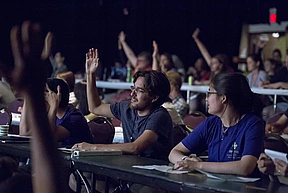
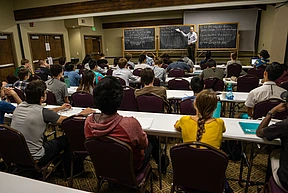
The Undergraduate Summer School (USS) at PCMI provides a unique opportunity for undergraduate students to learn some fascinating mathematical ideas in a setting that allows them to interact with mathematicians at all levels. The program itself is typically centered around lecture series delivered by leading experts on topics related to the main research theme of PCMI that summer. These lectures generally present material not usually part of an undergraduate curriculum, allowing students to become familiar with key ideas and techniques in the field, and often leading toward further research. The program is structured so that students at different levels will have many opportunities to learn new things.
The USS is not like a typical REU in several ways. The focus of the USS is more on the specialized lecture series and most importantly, the ability to interact informally with the many graduate students and researchers attending other parts of PCMI. Students can get to know mathematicians who have pursued a wide variety of career paths, and they can get a sense of which of these paths may be most appealing to them. Many USS participants report making connections that strongly influence their choice of graduate school. Interactions are fostered by the various informal social activities open to all PCMI participants, as well as daily "cross-program activities," which include lectures and presentations on topics of general mathematical interest. Members from all parts of PCMI may take part in the Experimental Math Lab, in which small groups of participants with close mentorship from a more senior mathematician investigate open-ended problems and report on their findings at the end of the three-week Summer Session.
The USS is open to undergraduate students at all levels, including those who have just completed their undergraduate studies. Participants are expected to be in residence for the entire three weeks of PCMI.
The PCMI Summer Session will be held June 28-July 18, 2026.
Research Theme: Knotted Surfaces in Four-Manifolds
In 2026 there will be one daily lecture series at 1pm, given by Mark Hughes (Brigham Young University), and the morning sessions will involve experimental mathematics component with open-ended problems and computational work. Here is an outline of Prof. Hughes' lectures:
Course Description: This course will explore low-dimensional topology through the lens of knotted objects in three and four dimensions. We’ll begin by discussing the theory of classical knots and links in R^3, including diagrams and Reidemeister moves, Seifert surfaces, prime factorizations, and knot invariants. These discussions will be used to set the stage to study what knotting looks like in the four-dimensional setting.
Moving up a dimension, we’ll build geometric intuition for knotted surfaces in R^4 using “movies” before developing diagrammatic formalisms such as broken surface diagrams and banded unlink diagrams. Like Reidemeister moves for classical knot diagrams, these frameworks also come with associated moves that allow us to encode deformations of surfaces in four dimensions. These techniques will be illustrated with numerous examples, including twist-spun knots, roll-spun knots, and ribbon knots. We’ll define various invariants of knotted surfaces and draw comparisons to classical knots whenever possible, to illustrate the similarities and differences between knotting in three and four dimensions.
We’ll then change the backdrop for our study of knotted surfaces from standard Euclidean space to arbitrary smooth 4-manifolds. We’ll define these manifolds using handle decompositions and see how they can be completely encoded using decorated link diagrams called Kirby diagrams. In this setting, knotted surfaces will be described by banded unlink diagrams, and a calculus of banded unlink moves will be used to construct deformations of these surfaces.
By the end of the program, students will have a toolkit for moving between classical knot theory and knotted surfaces in four dimensions, together with a map of where these two subjects illuminate one another.
Prerequisites: Linear algebra, multivariable calculus, and a course in abstract algebra (basic group theory only). Some prior exposure to topology will be helpful but not required.
All admitted students will be expected to contribute toward an inclusive and collegial atmosphere in this program. USS students come from many different backgrounds, and with different strengths, and we ask that all USS students commit to working together positively and noncompetitively.