School of Natural Sciences

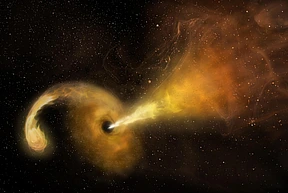
An international collaboration co-led by Andrew Mummery, Martin A. and Helen Chooljian Member (2025–30) in the School of Natural Sciences, has uncovered a universal rule governing one of the most powerful astronomical events in the universe. The scholars have shown that black holes—whether they are “stellar-mass” objects ten times the mass of our sun or supermassive giants millions of times heavier—fire powerful jets of material at the same juncture in their feeding cycles.

An international collaboration co-led by Andrew Mummery, Martin A. and Helen Chooljian Member (2025–30) in the School of Natural Sciences, has uncovered a universal rule governing one of the most powerful astronomical events in the universe. The team has shown that black holes—whether they are “stellar-mass” objects ten times the mass of our sun or supermassive giants millions of times heavier—fire powerful jets of material at the same juncture in their feeding cycles.

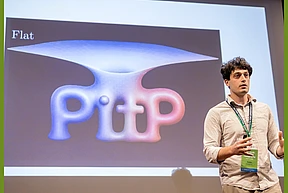
While scientists have demonstrated how the holographic principle works in hypothetical, highly curved spaces, such as Anti-de Sitter space—an approach pioneered by Juan Maldacena, Carl P. Feinberg Professor in the School of Natural Sciences—they are still trying to determine if equivalent field theories can replicate these effects in so-called "flat space." This year’s Prospects in Theoretical Physics (PiTP) program probed this fascinating topic.

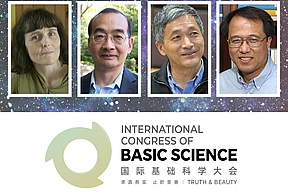
All three recipients of the 2026 International Congress of Basic Science (ICBS) Medal in Mathematics have links to the Institute’s School of Mathematics: Claire Voisin, Distinguished Visiting Professor (2014–15); frequent IAS scholar Horng-Tzer Yau; and Shou-Wu Zhang, Member (1991–92). Xiao-Gang Wen, Member (1990–91) and IBM Einstein Fellow (2022–23) in the School of Natural Sciences, was also recognized with a Physics Medal.