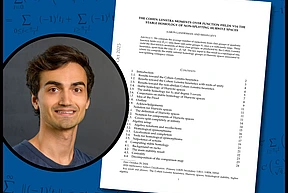
In an article for Nature, Ananyo Bhattacharya, science writer at the London Institute for Mathematical Sciences and biographer of John von Neumann, founding Professor (1933–55) in the School of Mathematics, lays out the significance of a "major advance" in research into the Langlands program—the "grand unified theory of mathematics" first laid out by Robert Langlands, Professor Emeritus in the School.
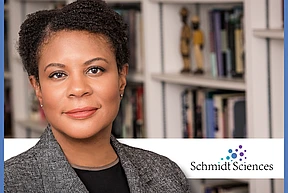
Does artificial intelligence have a role to play in pure mathematics—the kind of math still worked out on blackboards over decades? To interrogate this question, The New York Times spoke to IAS scholars from diverse disciplinary perspectives: Members Patrick Shafto (2021–23) and Andrew Granville (1989–91, 2007, 2009–10) in the School of Mathematics, and Alondra Nelson, Harold F. Linder Professor in the School of Social Science.
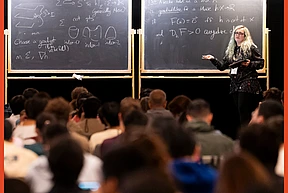
This May, the Institute for Advanced Study hosted its annual WAM program, a weeklong mathematical symposium for educators, students, and researchers that explored the theme of "Convexity and Combinatorics in Algebraic Geometry."
The Institute for Advanced Study is creating a new professorship in the theory of computing, supported by a gift from John Overdeck, the chair of the Institute’s Board of Trustees. The Betsey Lombard Overdeck Theory of Computing Professorship, in the Institute’s School of Mathematics, will be held by Irit Dveer Dinur, a preeminent theorist in computational complexity.
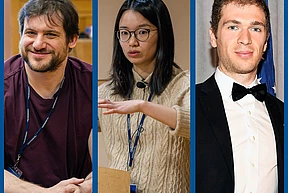
John Richard Bond, Member (2018) and Visitor (2012) in the School of Natural Sciences, received the Shaw Prize in Astronomy alongside George Efstathiou, Visitor (1986) in the School, for their pioneering research in cosmology, while Kenji Fukaya, Member (2002) in the School of Mathematics, was awarded the Shaw Prize in Mathematical Sciences for his field-shaping work on symplectic geometry.
Theoretical computer scientist Ryan Williams returns to the Institute this fall as the architect of a proof described as “stunning” and “massive.” Ben Brudaker of Quanta Magazine interviewed him about the revolutionary result.
Hong Wang, Member (2019–21) in the School of Mathematics, and Joshua Zahl of the University of British Columbia have announced a solution of the three-dimensional Kakeya conjecture.