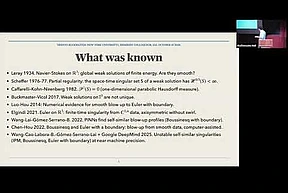
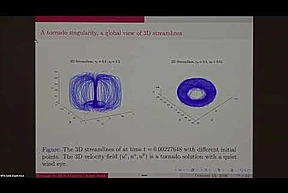
In this talk, we will discuss finite-time blow-up of the
three-dimensional incompressible Euler equations with smooth
space-time forcing. We will describe a multiscale mechanism in
which hydrodynamic instabilities amplify vorticity at
successively...
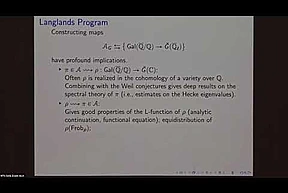
I will discuss OpenAI's proposed solution of the unramified
Langlands conjecture for function fields (problem #014 on the
list). Recently, the geometric Langlands conjecture in
characteristic 0 has been resolved, leading to substantial
progress...
Homotopy theory and category theory have the capability to
provide many insights into the structure of quantum field
theory. Using these tools I will explain a comprehensive
framework for characterizing the infrared (IR) phases of a
fermionic QFTs...
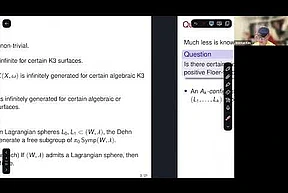
We introduce the notion of a Penner-type class of an exact
symplectomorphism on a Liouville domain with an Ak-configuration of
Lagrangian spheres for k⩾2, and prove that such a class has
positive Floer-theoretic entropy. As a corollary, we
construct...
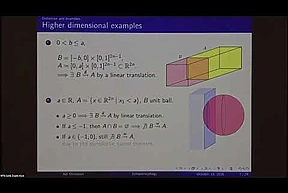
A symplectophagy is a symplectic isotopy satisfying certain
constraints reminiscent of the symplectic camel problem. In this
talk, I will introduce this notion and basic examples, and present
a new phenomenon of symplectic rigidity in the form of...
From their origin sofic groups have had a strong connection to
topological dynamics in that it was shown that sofic groups are
surjunctive - a dynamical notion. Later on, Lewis Bowen
developed an entropy theory for sofic groups. This led to
further...
OpenAI’s recently announced construction of a finite-time
singularity for the Navier–Stokes equations relies crucially on C∞
external forcing. After brief remarks on this development, I will
present two computer-assisted proofs for unforced...
The topology of Lagrangian submanifolds in the standard
symplectic vector space 𝐶𝑛 is a fundamental, yet poorly understood,
problem in symplectic topology. A related question, known as Maslov
class rigidity, concerns constraints on the Maslov...
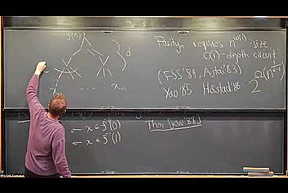
A cornerstone result in complexity theory is that O(1)-depth
circuits with unbounded fan-in AND/OR gates computing the parity of
an n bit string must have exp(n) size. Two completely different
proofs of this are known, both dating back to the 1980's...