If f is a real polynomial and A and B are finite sets of
cardinality n, then Elekes and Ronyai proved that either f(A×B) is
much larger than n, or f has a very specific form (essentially,
f(x,y)=x+y). In the talk I will tell about an analogue of...
Given an area-preserving surface diffeomorphism, what can one
say about the topological properties of its periodic orbits? In
particular, a finite set of periodic orbits gives rise to a braid
in the mapping torus, and one can ask which isotopy...
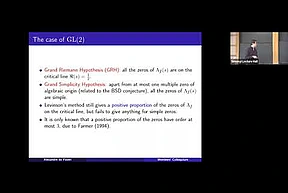
Zeros of L-functions have been extensively studied, due to their
close connection to arithmetic problems. Despite several precise
conjectures about their behavior, our unconditional understanding
of them remains limited. In this talk we will discuss...
Several classical results in Ramsey theory (including famous
theorems of Schur, van der Waerden, Rado) deal with finding
monochromatic linear patterns in two-colourings of the
integers. Our topic will be quantitative extensions of such
results. A...
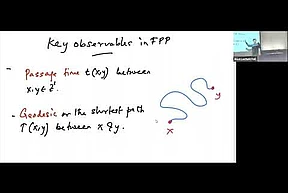
Planar last passage percolation models are canonical examples of
stochastic growth, polymers and random geometry in the
Kardar-Parisi-Zhang universality class, where one considers
oriented paths between points in a random environment accruing
the...
The question of stability of approximate group homomorphisms was
first formulated by Ulam in the 1940s. One of the most famous
results in this area is Kazhdan's 1982 result on stability of
approximate unitary representations of an amenable group...
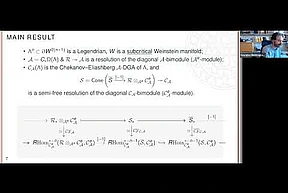
The duality long exact sequence relates linearised Legendrian
contact homology and cohomology and was originally constructed by
Sabloff in the case of Legendrian knots. We show how the duality
long exact sequence can be generalised to a relative...
In this lecture I will present basic elements of the theory of
nonlocal games from quantum information theory and give some
examples. I will then introduce the idea of "compressing" the
complexity of nonlocal games, and show how the right form of...
Erdős-style geometry is concerned with combinatorial questions
about simple geometric objects, such as counting incidences between
finite sets of points, lines, etc. These questions can be typically
viewed as asking for the possible number of...
Given n∈ℕ and ξ∈ℝ, let τ(n;ξ)=∑d|ndiξ. Hall and Tenenbaum asked
in their book \textit{Divisors} what is the value of
maxξ∈[1,2]|τ(n;ξ)| for a ``typical'' integer n. I will present work
in progress, carried out in collaboration with Louis-Pierre...