Planar last passage percolation models are canonical examples of
stochastic growth, polymers and random geometry in the
Kardar-Parisi-Zhang universality class, where one considers
oriented paths between points in a random environment accruing
the...
The question of stability of approximate group homomorphisms was
first formulated by Ulam in the 1940s. One of the most famous
results in this area is Kazhdan's 1982 result on stability of
approximate unitary representations of an amenable group...
The duality long exact sequence relates linearised Legendrian
contact homology and cohomology and was originally constructed by
Sabloff in the case of Legendrian knots. We show how the duality
long exact sequence can be generalised to a relative...
In this lecture I will present basic elements of the theory of
nonlocal games from quantum information theory and give some
examples. I will then introduce the idea of "compressing" the
complexity of nonlocal games, and show how the right form of...
Erdős-style geometry is concerned with combinatorial questions
about simple geometric objects, such as counting incidences between
finite sets of points, lines, etc. These questions can be typically
viewed as asking for the possible number of...
Given n∈ℕ and ξ∈ℝ, let τ(n;ξ)=∑d|ndiξ. Hall and Tenenbaum asked
in their book \textit{Divisors} what is the value of
maxξ∈[1,2]|τ(n;ξ)| for a ``typical'' integer n. I will present work
in progress, carried out in collaboration with Louis-Pierre...
The three problems referred to in the title originate in the
theory of von Neumann algebras, C* algebras, and quantum
information theory respectively. Each of them has been a deep
long-standing open problem in its respective area. Surprisingly,
the...
In the first story we wonder about the ubiquity of the
free field and look at a few characterisation theorems. In the
second story we discuss the mutually benefiting relationship
between the discrete free field and the O(N) spin model. Finally,
in...
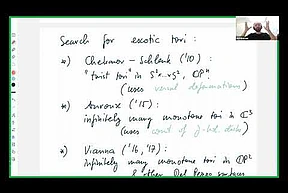
In this talk we discuss the existence of a new type of rigidity
of symplectic embeddings coming from obligatory intersections with
symplectic planes. This is based on a joint work with P.
Haim-Kislev and R. Hind.