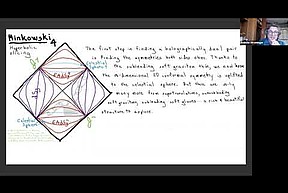
I will discuss progress towards understanding the relationship
between the gravitational path integral and the partition function
via the gravitational free energy (more generally the generating
functional). A proper computation of the free energy...
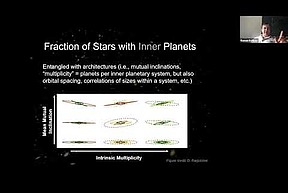
NASA's Kepler mission conducted a large survey of planetary
systems. Recently, we have advanced from measuring occurrence
rates as a function of planet size and period to characterizing the
intrinsic distribution of planetary system
architectures. ...
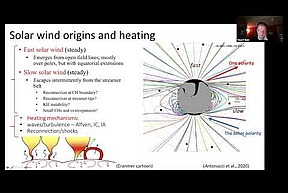
The physics of astrophysical coronal heating and the origin of the
slow solar wind remain compelling problems in heliospheric physics,
and plasma astrophysics more generally. The NASA Parker Solar Probe
mission was launched in late 2018 and has...
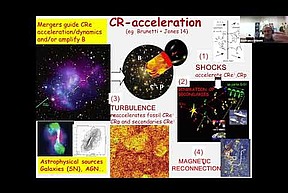
Galaxy clusters and cosmic filaments are the largest structures
in the Universe. During mergers between clusters shocks and
turbulence are driven in the intra-cluster-medium (ICM) and
dissipate a fraction of their energy into particle
acceleration...
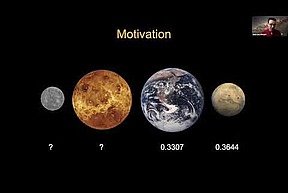
Earth-based radar observations in 2006–2019 enable the first
measurement of the spin precession rate and moment of inertia of
Venus. The observations also show that the spin period of the solid
planet changes by tens of minutes. The length-of-day...
It’s been a fantastic decade for black hole studies, highlighted
by the 2017 and 2020 Nobel Prizes in Physics. Multiple Galactic
Center research groups, the Event Horizon Telescope, and LIGO/Virgo
continue to bring rapid-fire new observations to...
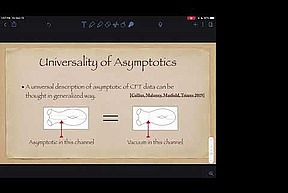
We consider the universality of existence and saturation of
asymptotic bounds in various quantities in 2D CFT. In particular,
we focus on previously derived upper and lower bounds on the number
of operators in a window of scaling dimensions [Δ−δ,Δ+δ...
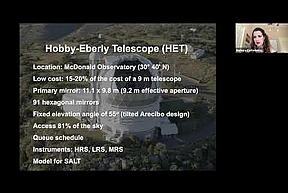
I will present the first results of the survey of all white
dwarfs (WD) that were observed in the Hobby-Eberly Telescope Dark
Energy Experiment (HETDEX) using the Visible Integral-field
Replicable Unit Spectrograph (VIRUS). The final outcome will
be...