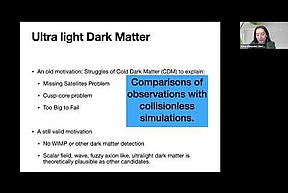
A dark matter candidate lighter than about 30 eV exhibits wave
behavior in a typical galactic environment. Examples include the
QCD axion as well as other axion-like-particles. We review the
particle physics motivations, and discuss experimental and...
One of the key objectives of modern astrophysics is to
understand the formation and evolution galaxies. In this regard,
the Milky Way is a critical testing ground for our theories of
galaxy formation. However, dissecting the assembly history of
the...
Spacetime wormholes have played an important role in
recent progress in black hole physics. However, in the context of
AdS/CFT, these wormholes lead to a basic puzzle: the "factorization
problem", introduced by Maldacena and Maoz. In this talk we...
High-precision astrometric data from space observatories, such
as the Hubble Space Telescope (HST) and Gaia, are revolutionizing
our ability to study the Local Group. 6D phase space measurements
(3-dimensional position and velocity) now make it...
Black holes create the most extreme gravitational fields
imaginable, and therefore offer a unique and unprecedented
opportunity to test our current understanding of gravity. We've
known about the existence of black holes in space for many years
but...
Debris disks are signposts of mature planetary systems, and
resolved images of dust grains act like test particles that trace
the dynamics of embedded planets. I will describe ongoing efforts
with the Atacama Large Millimeter/Submillimeter Array...
We show that a naïve application of the quantum extremal surface
(QES) prescription can lead to paradoxical results and must be
corrected at leading order. The corrections arise when there is a
second QES (with strictly larger generalized entropy at...
There are a few well-known ways for quantum mechanical,
many-body systems to avoid coming to thermal equilibrium. For
example, we know of two classes of systems -- integrable systems,
and many-body localized systems -- for which conservation
laws...
Why do many stars host close-in chains of super-Earths? Why are
eccentric gas giants found in some inner planetary systems? What
determines which of these outcomes will occur around a particular
star? I will present a possible framework for...
I will discuss properties of phases of matter in systems with a
global U(1) symmetry and a (possibly discrete) translation
symmetry. The low energy theory of such systems is strongly
constrained by these symmetries. I will give a framework to...