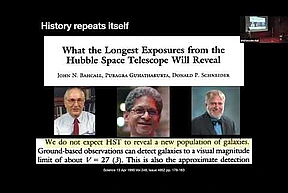
The James Webb Space Telescope (JWST) is finding earlier and
brighter sources than expected. In this talk I will explore how
these new observations fit (or don’t) within our cosmological and
galaxy-formation models. First, I will discuss the...
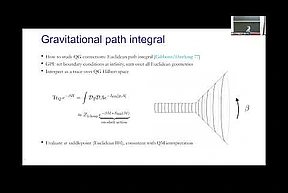
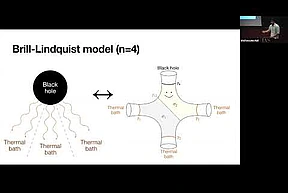
Over the last few years it has been understood that black holes
sufficiently close to extremality receive large quantum gravity
corrections from large fluctuations of the metric. These
corrections modify standard properties of near extremal
black...
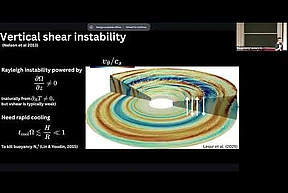
Planets are built from small dust grains embedded in gaseous
protoplanetary disks. As such, the associated gas dynamics and
dust-gas interactions play key roles in modern theories of planet
formation and evolution. In particular, several...
The distribution of matter on very large scales - the so-called
large-scale structure - contains clues, hidden within its
statistics, about the origin and evolution of the Universe. While
the gravity-only evolution of dark matter can be modelled...