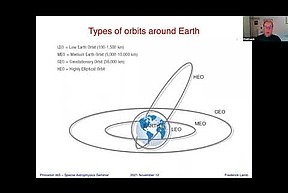
Compact mass-spring models can measure remarkably small
deformations while conserving angular momentum. We use them within
an N-body code to simulate tidal evolution of viscoelastic spinning
objects, tying simulated rheology to spin dynamics...
The Vera C. Rubin Observatory Legacy Survey of Space and Time
(LSST) will produce several billion photometric redshifts
(photo-z's), enabling cosmological analyses to select a
subset of galaxies with the most accurate photo-z.
We perform initial...
I will present a recent numerical study on the generation and
the amplification of magnetic fields in the Universe. Through
cosmological simulations of galaxy formation, we have studied the
Biermann battery process that drives microscopic current...
Dark matter halos are the fundamental building blocks of cosmic
large-scale structure. Improving our theoretical understanding of
their evolution and formation is an essential step towards
understanding how galaxies form. I will present a deep...
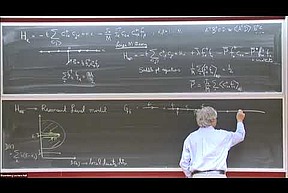
I will discuss a large-N bosonic quantum mechanical
sigma-model with a spherical target space subject to disordered
interactions, more colloquially known as the p-spin spherical
model. Replica symmetry is broken at low temperatures and
for...
Based on https://arxiv.org/abs/2106.01373.
We study a model for explaining the apparent deviation of the muon
anomalous magnetic moment, (g-2), from the Standard Model
expectation. There are no new scalars and hence no new hierarchy
puzzles beyond...
Quantum many-body systems are very hard to simulate, since
computational resources (time and memory) typically grow
exponentially with the system size. However, quantum computers or
analog quantum simulators may perform that task in a much
more...