Periodic bounce orbits are generalizations of billiard
trajectories in the presence of a potential. Using an approximation
technique by Benci-Giannoni we prove existence of periodic bounce
orbits of prescribed energy. At...
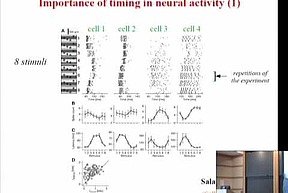
Boolean Threshold Functions (BTF) arise in many contexts,
ranging from computer science and learning theory to theoretical
neurobiology. In this talk, I will present non-rigorous approaches
developed in the statistical physics of disordered...
In this talk we will discuss recent progresses meant as a
contribution to the GLS-project, the second generation proof of the
Classification of Finite Simple Groups (jointly with R. Lyons, R.
Solomon, Ch. Parker).
In this talk we shall discuss the Cartan geometry of the
rotating Kepler problem. The rotating Kepler problem appears as the
limit of the restricted planar three-body body when one of the
masses goes to zero. As such...
Given a cuspidal automorphic representation of GL(n) which is
regular algebraic and conjugate self-dual, one can associate to it
a Galois representation. This Galois representation is known in
most cases to be compatible with local Langlands...
Using the spectral multiplicities of the standard torus, we
endow the Laplace eigenspace with Gaussian probability measure.
This induces a notion of a random Gaussian Laplace eigenfunctions
on the torus. We...
Abstract: In addition to formal definitions and theorems,
mathematical theories also contain clever, context-sensitive
notations, usage conventions, and proof methods. To mechanize
advanced mathematical results it is essential to capture
these...
The restricted 3-body problem has an intriguing dynamics. A deep
observation of Jacobi is that in rotating coordinates the problem
admits an integral. In joint work with P. Albers, G. Paternain and
O. van Koert, we...
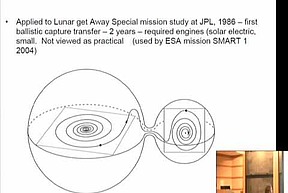
The problem of capture in the planar restricted three-body
problem is addressed. In particular, weak capture is described,
which occurs at a complicated region called the weak stability
boundary, where the motion is...
Given data drawn from a mixture of multivariate Gaussians, a
basic problem is to accurately estimate the mixture parameters. We
provide a polynomial-time algorithm for this problem for any fixed
number ($k$) of Gaussians in $n$ dimensions (even...