A satisfying theory for star or planet formation should not
consider these processes in isolation. With the power of recent
observational surveys, we are well positioned to test detailed
theoretical models of multiple-star formation and orbital...
Fracton phases of matter exhibit striking behaviour which
seemingly renders them beyond the standard topological quantum
field theory (TQFT) paradigm for gapped quantum phases. In this
talk, I will discuss progress towards understanding fracton...
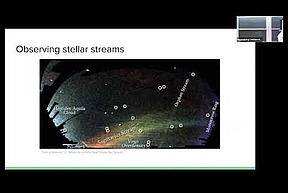
Large-area surveys such as Gaia have given us an unprecedented
amount of data on stars in the Milky Way. One of the largest
ongoing challenges in understanding the present-day structure and
formation history of our Galaxy (i.e. Galactic archaeology)...
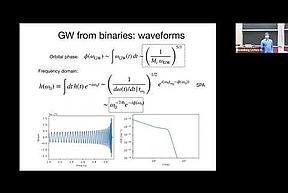
After decades of preparation, the era of gravitational wave
astronomy has begun. The gravitational wave detectors, LIGO and
Virgo, have published a catalog of 90 events of coalescing compact
objects including black holes and neutron stars. I will...
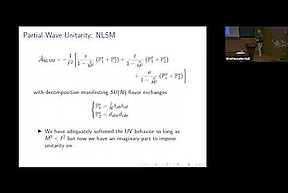
In the first half of the talk, I will review the notion of
non-invertible symmetries and how they help us to analyze certain
strongly coupled QFTs like 2d Adjoint QCD. Then, I discuss the
representation theory of non-invertible symmetries and use
it...
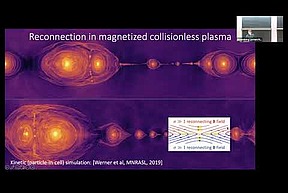
Astronomical observations indicate that coherent, dynamically
important magnetic fields are ubiquitous in the Universe. However,
neither the origin problem -- what are the physical mechanisms that
generate the initial ``seed'' magnetic fields —- nor...
A primary scientific outcome of the Apollo program was the giant
impact theory for lunar origin, in which a collision at the end of
Earth’s main accretionary phase creates a disk from which the Moon
forms. In the past decade, the nature of a Moon...
Gravity plays the central role in structure formation and
evolution in astronomical scales. Despite the apparently simple
inverse square law for the gravitational force in the
non-relativistic regime, the dynamics of self-gravitating
many-body...
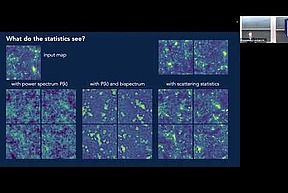
Millimeter-wave surveys of the sky have the potential for
yielding a wealth of information about our universe from the first
instants of its existence to our own solar system. I will describe
how modern measurements of the cosmic microwave...