The (small) quantum connection is one of the simplest objects
built out of Gromov-Witten theory, yet it gives rise to a
repertoire of rich and important questions such as the Gamma
conjectures and the Dubrovin conjectures. There is a very
basic...
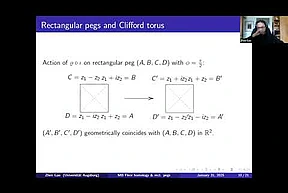
The rectangular peg problem, an extension of the square peg
problem, is easy to outline but challenging to prove through
elementary methods. In this talk, I discuss how to show the
existence and a generic multiplicity result assuming the
Jordan...
In 2008, looking to bound the face vectors of tropical linear
spaces, Speyer introduced the g-invariant of a matroid, defined in
terms of exterior powers of tautological bundles on Grassmannians.
He proved its coefficients nonnegative for matroids...
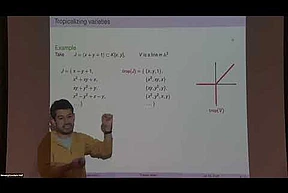
Tropical ideals are combinatorial objects that abstract the
behavior of the collections of subsets of lattice points that arise
as the supports of all polynomials in an ideal. Their structure is
governed by a sequence of ‘compatible’ matroids and...
Expressing combinatorial invariants of matroids as intersection
numbers on algebraic varieties has become a popular tool in
algebraic combinatorics. Several conjectured inequalities among
combinatorial data can be traced back to positivity results...
In 2008, looking to bound the face vectors of tropical linear
spaces, Speyer introduced the g-invariant of a matroid, defined in
terms of exterior powers of tautological bundles on Grassmannians.
He proved its coefficients nonnegative for matroids...
Suppose f is a function with Fourier transform supported on the
unit sphere in Rd. Elias Stein conjectured in the 1960s that the Lp
norm of f is bounded by the Lp norm of its Fourier transform, for
any p>2d/(d−1). We propose to study this...
Let Y be a symplectic divisor of X, ω. In the Kahler setting,
Givental's Quantum Lefschetz formula relates certain Gromov-Witten
invariants (encoded by the G function) of X and Y. Given an
Lagrangian L in (Y, ω|Y), we can lift it to a Lagrangian L'...
In this talk, we present a new method to solve algorithmic and
combinatorial problems by (1) reducing them to bounding the
maximum, over x in {-1, 1}^n, of homogeneous degree-q multilinear
polynomials, and then (2) bounding the maximum value...
In the late 1800s, in the course of his study of classical
problems of number theory, the young Hermann Minkowski discovered
the importance of a new kind of geometric object that we now call a
convex set. He soon developed a rich theory for...