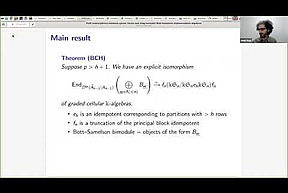
We construct an explicit isomorphism between certain truncations
of quiver Hecke algebras and Elias-Williamson's diagrammatic
endomorphism algebras of Bott-Samelson bimodules. As a corollary,
we deduce that the decomposition numbers of these...
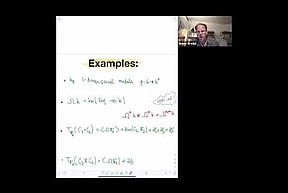
The Picard group of the stable module category of a finite group
plays a role in many parts of modular representation theory. It was
calculated when the group is an abelian p-group, by pioneering work
of Dade in the 1970's, and a classification for...
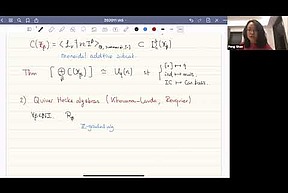
We explain an equivalence of categories between a module
category of quiver Hecke algebras associated with the Kronecker
quiver and a category of equivariant perverse coherent sheaves on
the nilpotent cone of type A. This provides a link between
two...
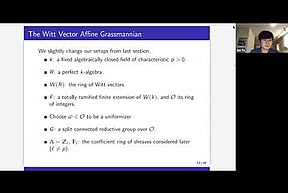
The geometric Satake equivalence establishes a link between two
categories: the category of spherical perverse sheaves on the
affine Grassmannian and the category of representations of the
Langlands dual group. It has found many important...
In the theory of turbulence, a famous conjecture of Onsager
asserts that the threshold Hölder regularity for the total kinetic
energy conservation of (spatially periodic) Euler flows is 1/3. In
particular, there are Hölder continuous Euler flows...
There are two categorical realizations of the affine Hecke
algebra: constructible sheaves on the affine flag variety and
coherent sheaves on the Langlands dual Steinberg variety. A
fundamental problem in geometric representation theory is to
relate...
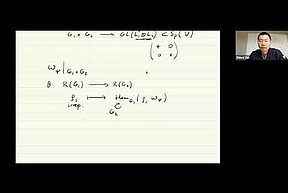
The theta correspondence of Roger Howe gives a way to connect
representations of different classical groups. We aim to geometrize
the theta correspondence for groups over finite fields in the
spirit of Lusztig's character sheaves. Given a reductive...
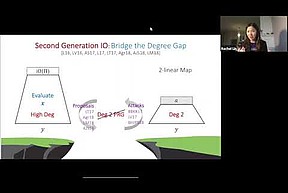
Indistinguishability obfuscation, introduced by [Barak et. al.
Crypto’2001], aims to compile programs into unintelligible ones
while preserving functionality. It is a fascinating and powerful
object that has been shown to enable a host of new...
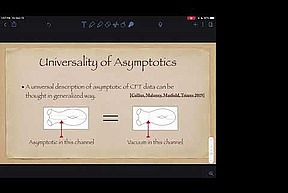
We consider the universality of existence and saturation of
asymptotic bounds in various quantities in 2D CFT. In particular,
we focus on previously derived upper and lower bounds on the number
of operators in a window of scaling dimensions [Δ−δ,Δ+δ...