NASA's Kepler mission conducted a large survey of planetary
systems. Recently, we have advanced from measuring occurrence
rates as a function of planet size and period to characterizing the
intrinsic distribution of planetary system
architectures. ...
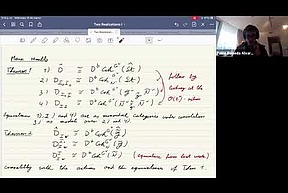
Before the "geometric Satake equivalence" there was a
decategorified version of it which however contained most of its
essential features. In my talk I will talk about some of the ideas
which have led to this theory. In particular I will explain
the...
Several well-known open questions (such as: are all groups
sofic/hyperlinear?) have a common form: can all groups be
approximated by asymptotic homomorphisms into the symmetric
groups Sym(n)Sym(n) (in the sofic case) or the finite
dimensional...
The physics of astrophysical coronal heating and the origin of the
slow solar wind remain compelling problems in heliospheric physics,
and plasma astrophysics more generally. The NASA Parker Solar Probe
mission was launched in late 2018 and has...
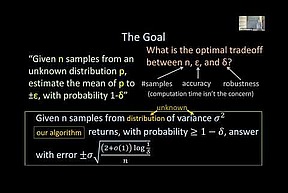
I will discuss techniques, structural results, and open problems
from two of my recent papers, in the context of a broader area of
work on the motivating question: "how do we get the most from our
data?"
For the incompressible Navier-Stokes equations, classical
results state that weak solutions are unique in the so-called
Ladyzhenskaya-Prodi-Serrin regime. A scaling analysis suggests that
classical uniqueness results are sharp, but current...
We present an overview of elementary methods to study extensions
of modular representations of various types of "groups". We shall
begin by discussing actions of an elementary
abelian pp-group, E=(Z/p)rE=(Z/p)r, on finite dimensional
vector spaces...
What combinatorial properties are likely to be satisfied by a
random subspace over a finite field? For example, is it likely that
not too many points lie in any Hamming ball of fixed radius? What
about any combinatorial rectangle of fixed side...
Let C be a class of groups. (For example, C is a class of all
finite groups, or C is a class of all finite symmetric groups.) I
give a definition of approximations of a group G by groups from C.
For example, the groups approximable by symmetric...
Galaxy clusters and cosmic filaments are the largest structures
in the Universe. During mergers between clusters shocks and
turbulence are driven in the intra-cluster-medium (ICM) and
dissipate a fraction of their energy into particle
acceleration...