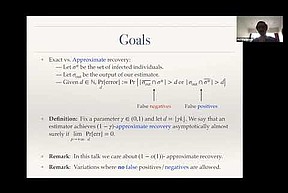
The talk will focus on the question of whether existing
symplectic methods can distinguish pseudo-rotations from rotations
(i.e., elements of Hamiltonian circle actions). For the projective
plane, in many instances, but not always, the answer is...
The linkage principle says that the category of representations
of a reductive group GG in positive characteristic
decomposes into "blocks" controlled by the affine Weyl group. We
will discuss the beautiful geometric proof of this result that
Simon...
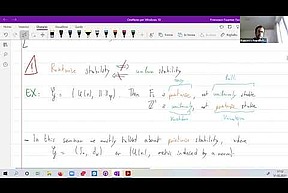
Determining whether or not a given finitely generated group is
permutation stable is in general a difficult problem. In this talk
we discuss work of Becker, Lubotzky and Thom which gives, in the
case of amenable groups, a necessary and sufficient...
Symplectic implosion was developed to solve the problem that the
symplectic cross-section of a Hamiltonian K-space is usually not
symplectic, when K is a compact Lie group. The symplectic implosion
is a stratified symplectic space, introduced in a...
Smith theory is a type of equivariant localization with respect
to a cyclic group of prime order pp, with coefficients in a
field of the same characteristic pp. It has been the source of
various recent advances in modular representation theory and...
The rigorous calculation of the ground state energy of dilute
Bose gases has been a challenging problem since the 1950s. In
particular, it is of interest to understand the extent to which the
Bogoliubov pairing theory correctly describes the ground...
The talk is about convolution in the setting of geometric
representation theory. What are its formal properties? As a
starting point, let G be a group and let D(G) be the derived
category of constructible sheaves on it. Convolution turns D(G)
into a...
The aim of this talk is to show that C*-algebras are useful for
studying stability of groups. In particular we will discuss some
obstructions for Hilbert-Schmidt stability of groups, obtain a
complete characterization of Hilbert-Schmidt stability...