While by a result of McDuff the space of symplectic embeddings
of a closed 4-ball into an open 4-ball is connected, the situation
for embeddings of cubes C4=D2×D2 is very different. For instance,
for the open ball B4 of capacity 1, there exists an...
Eliashberg and Thurston showed that taut foliations on
3-manifolds can be approximated by tight contact structures. I will
explain a new approach to this theorem which allows one to control
the resulting Reeb flow and hence produce many hypertight...
Siegel has recently defined ‘higher’ symplectic capacities using
rational SFT that obstruct symplectic embeddings and behave well
with respect to stabilisation. I will report on joint work with
Julian Chaidez that relates these capacities to algebro...
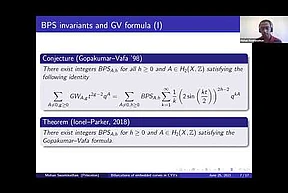
I will describe my recent work, joint with Shaoyun Bai, which
studies a class of bifurcations of moduli spaces of embedded
pseudo-holomorphic curves in symplectic Calabi-Yau 3-folds and
their associated obstruction bundles. As an application, we
are...
Tensors occur throughout mathematics. Their rank, defined in
analogy with matrix rank, is however much more poorly understood,
both from a structural and algorithmic viewpoints.
This will be an introductory talk to some of the basic
issues...
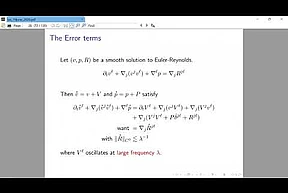
I will discuss the construction of continuous solutions to the
incompressible Euler equations that exhibit local dissipation of
energy and the surrounding motivations. A significant open
question, which represents a strong form of the Onsager...