A few months ago, a group of theoretical computer scientists
posted a paper on the Arxiv with the strange-looking title "MIP* =
RE", impacting and surprising not only complexity theory but also
some areas of math and physics. Specifically, it...
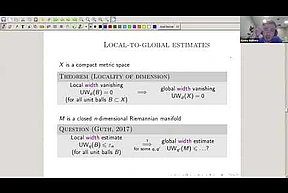
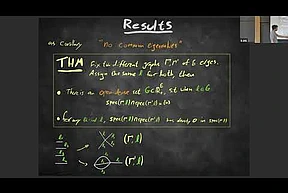
I will survey results related to graph comparison; graph
comparison is a certain type of restriction on a metric spaces
which is encoded by a given graph.
A few months ago, a group of theoretical computer scientists
posted a paper on the Arxiv with the strange-looking title "MIP* =
RE", impacting and surprising not only complexity theory but also
some areas of math and physics. Specifically, it...
A subgraph of an edge-coloured graph is called rainbow if all
its edges have distinct colours. The study of rainbow
subgraphs goes back to the work of Euler on Latin squares in the
18th century. Since then rainbow structures were the focus
of...
I will explain the notion of twisted generating function and
show that a closed exact Lagrangian submanifold LL in the
cotangent bundle of MM admits such a thing. The type of
function arising in our construction is related to Waldhausen's
tube space...
I will discuss some new results on the structure of Selmer
groups of finite Galois modules over global fields. Tate's
definition of the Cassels-Tate pairing can be extended to a pairing
on such Selmer groups with little adjustment, and many of
the...
We will discuss the following theorems concerning colimits taken
in the infinity-category of monoidal DG-categories. (No familiarity
with infinity-categories will be required or assumed.) The affine
Hecke category is the monoidal colimit of its...
This expository talk will try to bridge the first examples of
"almost commuting" unitary matrices that are not almost "commuting
unitaries" due to Voiculescu to a more sophisticated and very
beautiful construction of examples by Gromov and Lawson in...
This talk gives an introduction on how to quickly solve linear
systems where the matrix of the system is the Laplacian matrix of
any undirected graph. No prior familiarity with optimization is
assumed. In the process, we will cover: