Two recent and seemingly-unrelated techniques for proving mixing
bounds for Markov chains are:
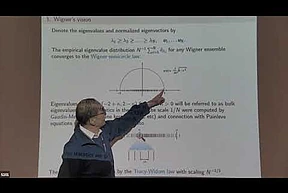
(i) the framework of Spectral Independence, introduced by Anari,
Liu and Oveis Gharan, and its numerous extensions, which have given
rise to several...
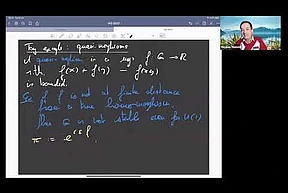
I will discuss a recent work constructing quasimorphisms on the
group of area and orientation preserving homeomorphisms of the
two-sphere. The existence of these quasimorphisms answers a
question of Entov, Polterovich, and Py. As an
immediate...
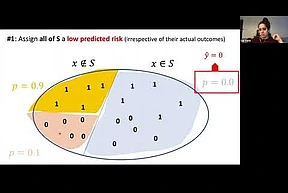
As machine learning is widely deployed, it is increasingly
important to ensure that predictors will perform well not only on
average (across the entire population), but also on specific
socially salient subgroups. In this talk, I will present...
This lecture serves as a background for the upcoming talk by
Bharatram Rangarajan. I will review some aspects of bounded
cohomology, including why it appears to have some relevance to
stability questions. I will then explain vanishing results
for...
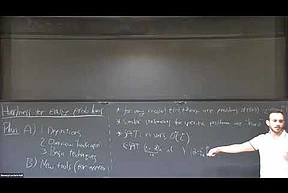
In recent years, a new “fine-grained” theory of computational
hardness has been developed, based on “fine-grained reductions”
that focus on exact running times for problems.
We follow the fashion of NP-hardness in a more delicate manner.
We...
I will describe how the orbit method can be developed in a
quantitative form, along the lines of microlocal analysis, and
applied to local problems in representation theory and global
problems involving the analysis of automorphic forms. This
talk...
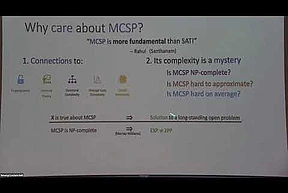
Understanding the complexity of the Minimum Circuit Size Problem
(MCSP) is a longstanding mystery in theoretical computer science.
Despite being a natural problem about circuits (given a Boolean
function's truth table, determine the size of the...
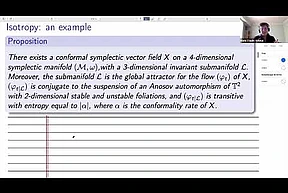
In a work with Jacques Fejoz, we consider the conformal dynamics
on a symplectic manifold , i.e. for which the symplectic form is
transformed colinearly to itself. In the non-symplectic case, we
study the problem of isotropy and uniqueness of...