Conformal blocks are fundamental objects in the conformal
bootstrap program of 2D conformal field theory and are closely
related to four dimensional supersymmetric gauge theory.
In this talk, I will demonstrate a probabilistic construction of
a...
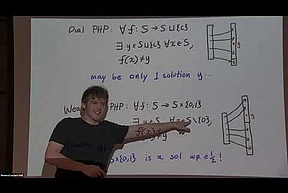
central topic in the theory of computation
is derandomization: say we have an algorithm
which flips coins to achieve some goal, and succeeds with high
probability. Can we transform this algorithm into a deterministic
procedure, while maintaining...
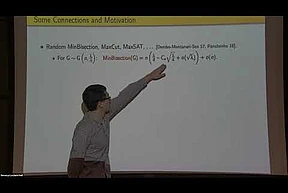
I will explain recent progress on computing approximate ground
states of mean-field spin glass Hamiltonians, which are certain
random functions in high dimension. While the asymptotic ground
state energy OPT is given by the famous Parisi formula...
A Diophantine upper bound on the dimensions of certain spaces of
holonomic functions was the main ingredient in our proof with
Calegari and Tang of the 'unbounded denominators conjecture'
(presented by Tang in last year's number theory seminar)
from...