The lifeblood of interactive proof systems is randomness,
without which interaction becomes redundant. Thus, a natural
long-standing question is which types of proof systems can indeed
be derandomized and collapsed to a single-message NP-type...
We consider a general system of interacting random loops which
includes several models of interest, such as the spin O(N) model,
the double dimer model, random lattice permutations, and is related
to the loop O(N) model and to the interacting Bose...
In this talk, we will discuss the behavior of the Yamabe flow on
an asymptotically flat (AF) manifold. We will first show the
long-time existence of the Yamabe flow starting from an AF manifold
and discuss the uniform estimates on manifolds with...
Algorithms for understanding data generated from distributions
over large discrete domains are of fundamental importance. In
this talk, we consider the sample complexity of *property testing
algorithms* that seek to to distinguish whether or not an...
The interchange process \sigma_T is a random permutation valued
process on a graph evolving in time by transpositions on its edges
at rate 1. On Z^d, when T is small all the cycles of the
permutation \sigma_T are finite almost surely. In dimension
d...
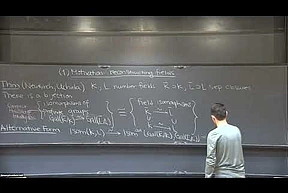
The Cohen-Lenstra heuristics give predictions for the
distribution of the class groups of a random quadratic number
field. Cohen and Martinet generalized them to predict the
distribution of the class groups of random extensions of a fixed
base field...
Lower scalar curvature bounds on spin Riemannian manifolds
exhibit remarkable rigidity properties determined by spectral
properties of Dirac operators. For instance, a fundamental result
of Llarull states that there is no smooth Riemannian metric
on...
This will be a survey talk about recent progress on pointwise
convergence problems for multiple ergodic averages along polynomial
orbits and their relations with the Furstenberg-Bergelson-Leibman
conjecture.
Expander graphs are fundamental objects in theoretical computer
science and mathematics. They have numerous applications in diverse
fields such as algorithm design, complexity theory, coding theory,
pseudorandomness, group theory, etc.