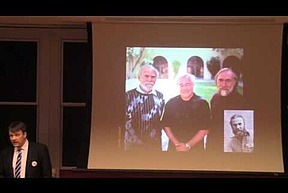
Enrico Bombieri, Freeman Dyson, Robbert Dijkgraaf, Dan Rockmore
Concinnitas is a collection of ten aquatints curated by Dan Rockmore and produced from the contributions of ten mathematicians and physicists in response to the prompt to transcribe their “most beautiful mathematical expression.” In this video from 2015, Robbert Dijkgraaf, Director and Leon Levy Professor, moderates a talk and Q&A with two contributors to Concinnitas, Enrico Bombieri and Freeman Dyson, as well as the portfolio curator, Dan Rockmore.
Environment plays a major in role in the evolution of galaxies.
This is particularly true of low mass dwarf galaxies where more
massive galaxies dramatically affect the local gravitational
potential. Isolated galaxies offer a unique test bed for...
Cosmic rays comprise only about one billionth of interstellar
particles in the Milky Way, but have as much energy as the thermal
gas. Low energy cosmic rays affect the chemistry and thermodynamics
of interstellar through collisional processes...
Richard Schwartz, Member (2003–04) in the School of Mathematics and
the Chancellor’s Professor of Mathematics at Brown University, will
talk about really large numbers, as well as the different sizes of
infinity and the different forms of infinite...
Recent results from Kepler and ground-based exoplanet surveys
suggest that low-mass stars are host to numerous small planets.
Since low-mass stars are intrinsically faint at optical
wavelengths, obtaining the Doppler precision necessary to detect...
https://www.ias.edu/sns/~baldauf/Bias/program.html
The interpretation of low-redshift galaxy surveys is more
complicated than the interpretation of CMB temperature
anisotropies. First, the matter distribution evolves nonlinearly at
low redshift...
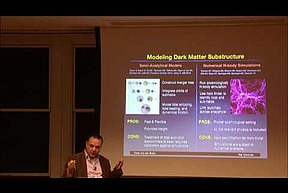
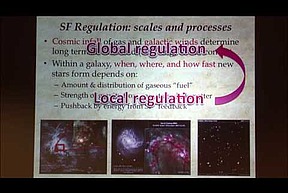
Galaxy formation is a complex, hierarchical, highly non-linear
process, which involves gravitational collapse of dark matter and
baryons, supersonic, highly compressible and turbulent flows of
gas, star formation, stellar feedback, as well as...
In this lecture, Tegmark surveys how humans have repeatedly
underestimated not only the size of the cosmos, but also the power
of the human mind to understand it using mathematical equations. He
explores how mathematics in physics has allowed us to...