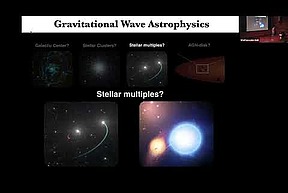
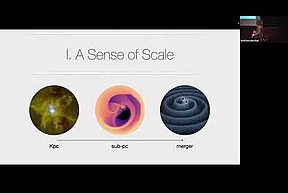
How and where do black hole mergers form in our Universe? After
10 years of GW science with LIGO/Virgo/Kagra, there still seems to
be no direct indication of what the underlying astrophysical
formation channels are. I will present ideas and ongoing...
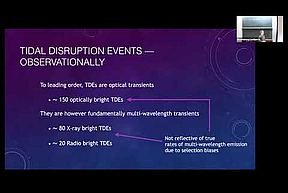
Tidal disruption events — where an unfortunate star is destroyed
by a previously quiescent supermassive black hole — offer a unique
probe of the low mass end of the supermassive black hole
population. Recent observational advances have lead to the...
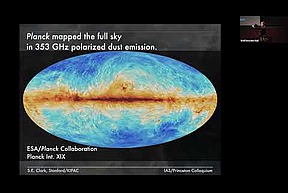
The interstellar medium (ISM) is a turbulent, multi-phase,
magnetic environment. It is home to vastly different gas phases,
from cold, dense clouds to hot, tenuous plasma. Magnetic fields
thread this interstellar environment, helping to sculpt...
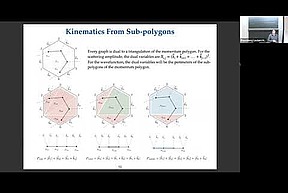
In this talk, I will discuss Cosmohedra. These are geometric
objects which encode the vacuum wavefunction for theories with
colored scalars with cubic interactions. I will start by
introducing the vacuum wavefunction, both in Minkowski and de
Sitter...
At the center of nearly every galaxy in the Universe resides a
supermassive black hole. When galaxies collide, their supermassive
black holes sink to the center of the newly forming galaxy. There
in this nascent galactic nucleus a supermassive black...
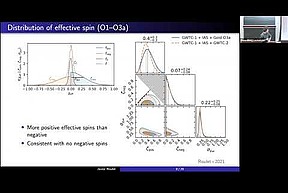
After ten years of gravitational-wave observations with the
LIGO–Virgo–KAGRA interferometers, over 200 signals from merging
black hole binaries have been detected, bringing us closer to
understanding how these systems form. Addressing this
question...
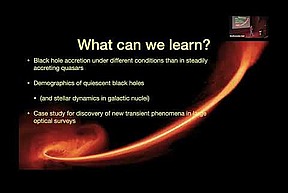
Over the last decade, large optical time-domain surveys have
systematized the discovery of transient flares of emission
associated with the tidal disruptions of stars by supermassive
black holes. These tidal disruption events (TDEs) are rare
events...
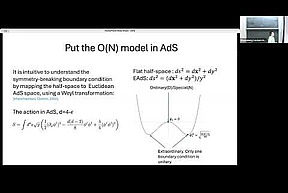
The $\epsilon$-expansion is a widely used technique to study
aspects of renormalization group flows and critical phenomena. In
this talk, I will discuss recent developments of the
$\epsilon$-expansion in the study of boundary and defect...
Cold Neptunes appear to be among the most abundant planets in
the Galaxy, yet their role in shaping planetary systems remains
poorly understood. We study the dynamical evolution of cold Neptune
systems born in resonant chains through disk-driven...
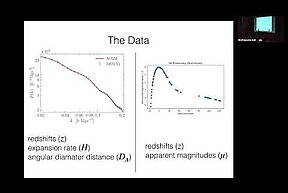
Cosmological data has opened up new vistas on fundamental
physics yet it is limited in its scope. While it has given us
tantalizing hints at how the Universe might be expanding, it is
unclear whether it can ever be used to find the
microphysical...