We revisit the computation of string correlation functions in
AdS3 with pure NS-NS flux from a worldsheet point of view. These
correlators contain all the perturbative information about the
spacetime CFT and the existence of winding strings in AdS3...
Conformal Field Theories (CFTs) have rich dynamics in heavy
states. We describe the constraints due to spontaneously broken
boost and dilatation symmetries in such states. The spontaneously
broken boost symmetries require the existence of new low...
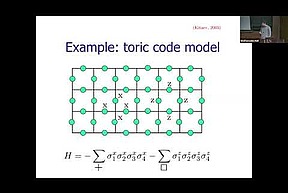
We will discuss emergent global symmetries, anomalies, and
dualities in various lattice models and their continuum field
theories. These include the ordinary XY model and some exotic
models related to fractons. We will find that many properties
that...
Supported by new observational capabilities, some of our basic
concepts in Milky Way research have changed over the last several
years. Our growing appreciation of the central bar of the Milky
Way, the radial migration of stars, the Galactic thick...
Black holes are never isolated in realistic astrophysical
environments; instead, they are often perturbed by complicated
external tidal fields. How does a black hole respond to these tidal
perturbations? In this talk, I will discuss both the...
Since the first detection of a gravitational wave event of the
merger of two neutron stars in 2017, two more detections in the
neutron star mass range have been announced. The first one,
GW190425, involved an unusually massive neutron star, the...
This is a continuation of a series of talks I have given in
recent years reporting on work with Jan Manschot, et. al.
There will be some repetition, and some updates and new
results. (See below for some relevant links.)
Manschot and I have...
The future interior of black holes in AdS/CFT can be described
in terms of a quantum circuit. We investigate boundary quantities
detecting properties of this quantum circuit. We discuss relations
between operator size, quantum complexity, and the...
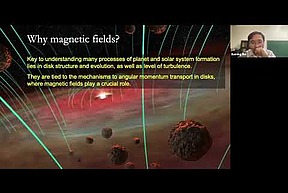
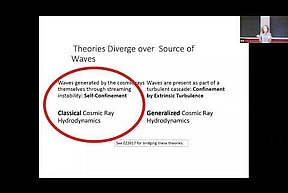
Many space and astrophysical plasmas, such as the solar wind,
radiatively inefficient accretion flows onto black holes, and the
intracluster medium of galaxy clusters (ICM), are hot and dilute,
which makes them weakly collisional or even...