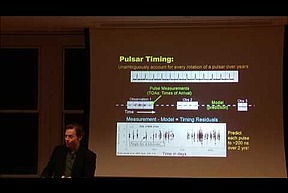
Pulsars are some of physics and astrophysics' most exotic
objects, and they have already earned two Nobel Prizes. We
currently know of about 2500 of them in our Galaxy, but a small
subset, the millisecond pulsars (MSPs), are truly remarkable.
These...
Advanced LIGO discovered cosmic gravitational waves and
surprised us with giant binary black-hole systems, just in time for
the 100th anniversary of Einstein's prediction. Gravitational waves
became the latest window on the Universe from violent...
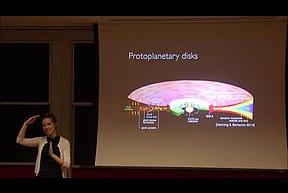
Exo-planets are common, and they span a large range of
compositions.The origins of this compositional diversity are
largely unconstrained. Among planets that are Earth-like, a second
question is how often such planets form hospitable to life.
A...
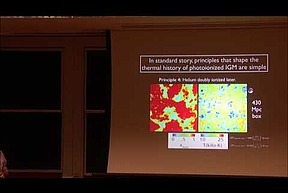
I will summarize the history of IGM temperature measurements
from the Lyman-alpha forest as well as the theory for the IGM
temperature after reionization. I will show that the simplest
theory for thermal evolution, which has little parametric...
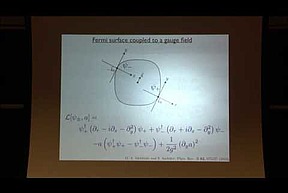
States of quantum matter without quasiparticles can be more
precisely characterized by their rapid approach to local thermal
equilibrium: this is argued to happen in a shortest possible time
of order (Planck’s constant)/((Boltmann’s constant)x...
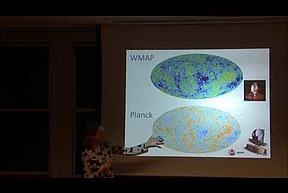
Measurements of the Cosmic Microwave Background radiation have
taught us a great deal about the origins and content of the
universe, but there is still more information to be extracted,
teaching us about the energetic moments in the early
universe...
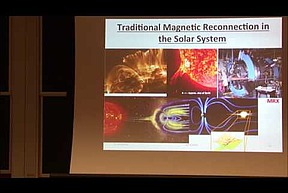
ABSTRACT ADDED - Many high-energy astrophysical sources —
pulsars, PWN, magnetars, GRBs, and AGN (including blazar) jets —
produce bright bursts of gamma-ray emission, often featuring rapid
variability and nonthermal spectra. This calls for a...
General Relativity is one of two foundational pillars of
physics, yet gravity is the most weakly tested of the fundamental
forces. Using the pristine solar system as a laboratory, we bump
into this pillar to see if it might fall. This talk will...