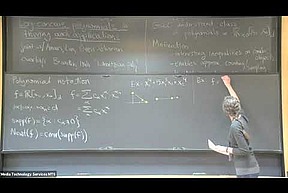
A polynomial with nonnegative coefficients is strongly
log-concave if it and all of its derivatives are log-concave as
functions on the positive orthant. This rich class of polynomials
includes many interesting examples, such as homogeneous real...
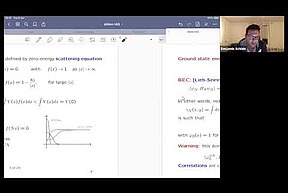
We consider systems of NN particles interacting
through a repulsive potential in the Gross-Pitaevskii regime. We
prove complete Bose-Einstein condensation and we determine the form
of the low-energy spectrum, in the limit of large NN. Our
results...
The celebrated Brunn-Minkowski inequality states that for
compact
subsets XX and YY of ℝdRd, m(X+Y)1/d≥m(X)1/d+m(Y)1/dm(X+Y)1/d≥m(X)1/d+m(Y)1/d where m(⋅)m(⋅) is
the Lebesgue measure. We will introduce a conjecture generalizing
this inequality to...
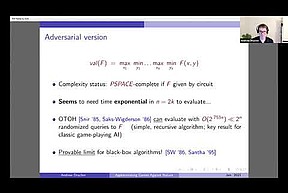
"Games against Nature" [Papadimitriou '85] are two-player games
of perfect information, in which one player's moves are made
randomly. Estimating the value of such games (i.e., winning
probability under optimal play by the strategic player) is
an...
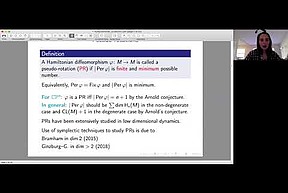
The talk will focus on the question of whether existing
symplectic methods can distinguish pseudo-rotations from rotations
(i.e., elements of Hamiltonian circle actions). For the projective
plane, in many instances, but not always, the answer is...
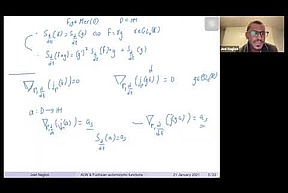
Over the last decades, following works around the Pila-Wilkie
counting theorem in the context of o-minimality, there has been a
surge in interest around functional transcendence results, in part
due to their connection with special points...
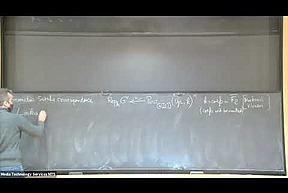
The linkage principle says that the category of representations
of a reductive group GG in positive characteristic
decomposes into "blocks" controlled by the affine Weyl group. We
will discuss the beautiful geometric proof of this result that
Simon...
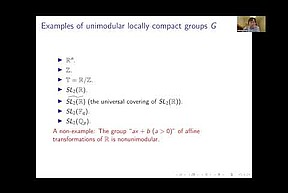
Determining whether or not a given finitely generated group is
permutation stable is in general a difficult problem. In this talk
we discuss work of Becker, Lubotzky and Thom which gives, in the
case of amenable groups, a necessary and sufficient...
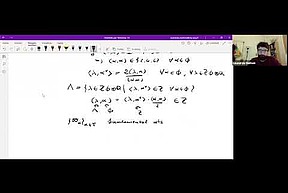
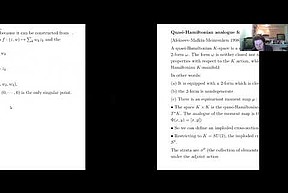
Symplectic implosion was developed to solve the problem that the
symplectic cross-section of a Hamiltonian K-space is usually not
symplectic, when K is a compact Lie group. The symplectic implosion
is a stratified symplectic space, introduced in a...