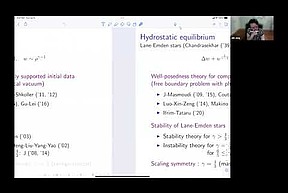
We discuss recent mathematical constructions of self-similar
gravitational collapse for Newtonian stars governed by the
Euler-Poisson system, known as Larson-Penston solutions for the
isothermal stars and Yahil solutions for polytropic stars,
and...
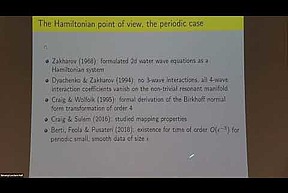
It is known since the work of Dyachenko & Zakharov
that for the weakly nonlinear 2d infinite depth water waves, there
are no 3-wave interactions and all of the 4-wave interaction
coefficients vanish on the non-trivial resonant manifold. In
this...
The lecture will discuss a joint work with Gregorio Baldi and
Bruno Klingler. Given a polarized Z-VHS over a complex,
smooth quasi-projective variety S, we describe some properties of
the Hodge locus, a countable union of algebraic subvarieties
of...
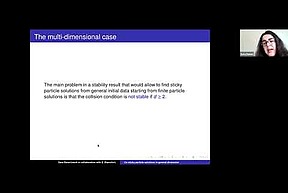
In this talk we consider the pressureless Euler system in
dimension greater than or equal to two. Several works have been
devoted to the search of solutions which satisfy the following
adhesion or sticky particle principle: if two particles of
the...
In this talk we will present a construction of global existence
of small solutions of the modified SQG equations, close to the
disk. The proof uses KAM theory and a Nash-Moser argument, and does
not involve any external parameters. We moreover prove...
Let M be a smooth manifold in an Euclidean space; consider the
motion of a material point on M in absence of friction. The
D'Alembert Principle says that the acceleration vector is
orthogonal to the tangent space to M, and this fact defines
the...
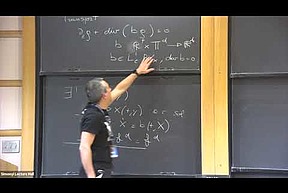
We consider the density properties of divergence-free vector
fields b∈L1([0,1],\BV([0,1]2)) which are ergodic/weakly
mixing/strongly mixing: this means that their Regular Lagrangian
Flow Xt is an ergodic/weakly mixing/strongly mixing measure...
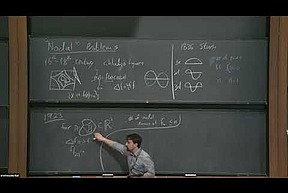
The study of nodal sets, i.e. zero sets of eigenfunctions, on
geometric objects can be traced back to De Vinci, Galileo, Hook,
and Chladni. Today it is a central subject of spectral geometry.
Sturm (1836) showed that the n-th eigenfunction of the...
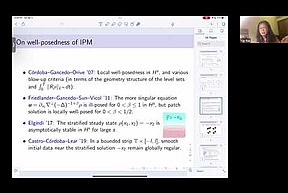
The incompressible porous media (IPM) equation describes the
evolution of density transported by an incompressible velocity
field given by Darcy’s law. Here the velocity field is related to
the density via a singular integral operator, which is...