IAS/PU Joint Astrophysics Colloquium

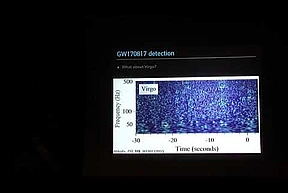
Hearing and Seeing GW170817

Daniel Holz

With the discovery of a binary neutron star coalescence in gravitational waves, and the discovery of an associated short gamma-ray burst, and the discovery of an associated optical afterglow, we have finally entered the era of gravitational-wave...

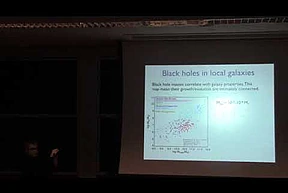
Massive black holes, weighing millions to billions of solar masses, inhabit the centers of today's galaxies. Black hole masses typically scale with properties of their hosts, such as bulge mass and velocity dispersion. The progenitors of these black...

Exploring the Galactic Halo with Gaia

Vasily Belokurov

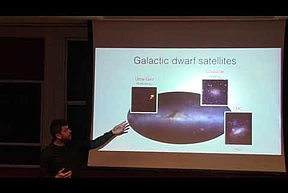
Gaia is a perfect halo explorer. It makes up for a relatively shallow depth with an array of features not available to other surveys/telescopes. These include stable photometry, impeccable star/galaxy separation and resilience to artefacts, not to...

Magnetars produce beautiful fireworks in x-rays and gamma-rays: small, large, and stupendous flares, fast quasi-periodic oscillations (QPOs), as well as transient increases of their luminosities on timescales of months to years. How the release of...
Circumgalactic Precipitation

Mark Voit

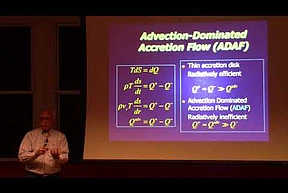
Feedback from a central supermassive black hole is an essential component of galaxy evolution models. Without it, those models cannot produce realistic massive galaxies and galaxy clusters. However, the black-hole feedback mechanism remains...