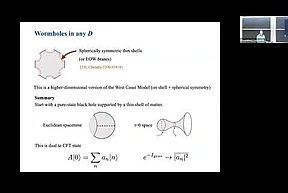
Some aspects of the black hole spectrum, coming from spacetime
wormhole contributions, can be modeled by a random matrix ensemble.
It is important to understand the appropriate ensemble for theories
with extended supersymmetry, since for example...
Perhaps the most important problem in physics or quantum
chemistry is to determine properties of the ground state of an
interacting system of fermions. As a quantum mechanical
problem, there may be no efficient classical witness to the ground
state...
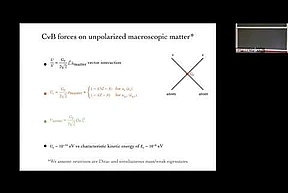
The CνB is a cosmological relic analogous to the CMB, and
contains information about the universe before it was
one-second-old. Reflection of relic neutrinos from the surface of
the Earth creates a significant local neutrino-antineutrino
asymmetry...
Supersymmetric black holes in Anti de-Sitter space have recently
been shown to have a large number of exactly degenerate
microstates. In the first part of the talk, we will review how AdS5
black hole microstates may be reliably counted in the dual N...
The conformal bootstrap equations in general dimension are an
infinite set of coupled non-linear equations in infinitely many
variables. According to the lore, the solutions of the full set of
equations correspond to physical CFTs. At the same time...
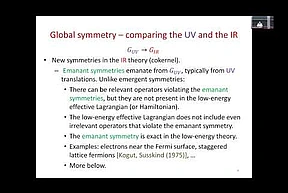
Higher symmetries in quantum field theory are novel concepts of
symmetry that involve extended operators such as Wilson lines in
gauge theory. We briefly review this formalism and then
discuss recent applications to particle physics, including
an...
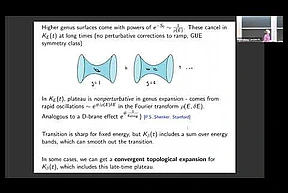
Black holes are expected to exhibit universal 'random matrix'
behavior at late times, indicative of quantum chaos. The
approach to a late-time plateau in the spectral form factor
(SFF) is a probe of this behavior. In this talk we study the SFF
in...
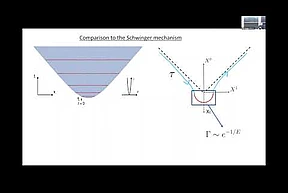
In certain time-dependent backgrounds there are nonstandard
light strings that are created classically at an instant and cannot
be approximated by particles. We discuss the implications of these
strings to black holes and cosmology.