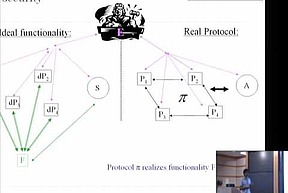
We prove completeness results for certain class of functions
which have implications for automatic proving of
universally-composable security theorems for ideal and real
functionalities composed of if-then-else programs with (uniform)
random number...
The complexity of simple stochastic games (SSGs) has been open
since they were defined by Condon in 1992. Such a game is played by
two players, Min and Max, on a graph consisting of max nodes, min
nodes, and average nodes. The goal of Max is to...
Recently there has been much interest in polynomial threshold
functions in the context of learning theory, structural results and
pseudorandomness. A crucial ingredient in these works is the
understanding of the distribution of low-degree...
Erdos conjectured that N points in the plane determine at least
c N (log N)^{-1/2} different distances. Building on work of
Elekes-Sharir, Nets Katz and I showed that the number of distances
is at least c N (log N)^{-1} . (Previous estimates had...
A ``tournament'' is a digraph obtained from a complete graph by
directing its edges, and ``colouring'' a tournament means
partitioning its vertex set into acyclic subsets (``acyclic'' means
the subdigraph induced on the subset has no directed cycles...
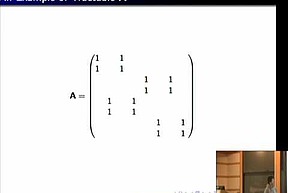
A (q,k,t)-design matrix is an m x n matrix whose pattern of
zeros/non-zeros satisfies the following design-like condition: each
row has at most q non-zeros, each column has at least k non-zeros
and the supports of every two columns intersect in at...
In a sequence of recent papers, Sudan and coauthors have
investigated the relation between testability of properties of
Boolean functions and the invariance of the properties with respect
to transformations of the domain. Linear-invariance is...
A hardness escalation method applies a simple transformation
that increases the complexity of a computational problem. Using
multiparty communication complexity we present a generic hardness
escalation method that converts any family of...
In recent joint work with Alex Arkhipov, we proposed a quantum
optics experiment, which would sample from a probability
distribution that we believe cannot be sampled (even approximately)
by any efficient classical algorithm, unless the polynomial...