Computer Science and Discrete Mathematics (CSDM)

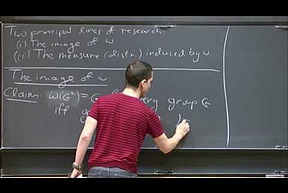
Let \(G\) be a finite group, and let \(a\), \(b\), \(c\),... be independent random elements of \(G\), chosen at uniform distribution. What is the distribution of the element obtained by a fixed word in the letters \(a\), \(b\), \(c\),..., such as \...

Colouring graphs with no odd holes

Paul Seymour
The chromatic number \(k(G)\) of a graph \(G\) is always at least the size of its largest clique (denoted by \(w(G)\)), and there are graphs with \(w(G)=2\) and \(k(G)\) arbitrarily large. On the other hand, the perfect graph theorem asserts that if...
A planar set that contains a unit segment in every direction is called a Kakeya set. These sets have been studied intensively in geometric measure theory and harmonic analysis since the work of Besicovich (1919); we find a new connection to game...
How can we produce randomness of almost perfect quality, in large quantities, and under minimal assumptions? This question is fundamental not only to modern day information processing but also to physics. Yet a satisfactory answer is still elusive...
An error-correcting code is called locally decodable if there exists a decoding algorithm that can recover any symbol of the message with high probability by reading only a small number of symbols of the corrupted codeword. There is a fundamental...