The albedo of a celestial body is the fraction of incident
starlight reflected by it. The study of the albedos of Solar System
objects is at least a century old, at least in the Western world.
As examples: Bond (1861) speculated on the near-unity...
Charge-exchange (CX) collisions of the solar wind (SW)
high-ionization-state minor ions with LISM neutrals are responsible
for much of X-ray production in the outer heliosphere. In this
talk, we discuss numerical modeling of the heliospheric CX X...
Interpreting observations of extreme astrophysical phenomena
requires a detailed understanding of particle acceleration in
astrophysical environments. These accelerated particles, known as
cosmic rays, approximately follow a power-law distribution...
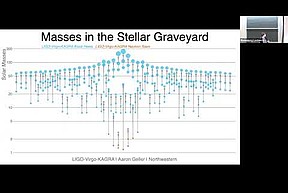
Gravitational waves have uncovered a treasure trove of nearly 90
merging black holes and neutron stars, each with its own unique
story to tell. In this talk, our focus centers on black hole spins,
seeking to decipher the secrets hidden within...
Detections of neutron stars in binaries through gravitational
waves offer a novel way to probe the properties of extremely dense
matter. In this talk I will describe the properties of the signals
we have observed, what they have already taught us...
The classical perspective of astrophysical discs models them as
being flat, circular and coplanar. However, a wealth of
observational evidence has highlighted the ubiquity of warped
geometries in a variety of contexts. This has motivated
theoretical...
This is an exciting time for stellar astrophysics as
high-cadence time domain surveys (Gaia, PTF, ZTF, ATLAS, Kepler,
TESS, and, in the near future, the Vera Rubin Observatory) are
revolutionizing the landscape of stellar studies by allowing
the...
Fast inward migration of planetary cores embedded in gaseous
disks is a common problem in the current planet formation paradigm.
Even though dust is ubiquitous in protoplanetary disks, its
dynamical role in the migration history of planetary embryos...
Driven by gravity, galaxies continuously grow through accretion
of smaller systems. Stellar streams are nice illustrations of this
hierarchical build-up, but the accreted stars quickly disperse. I
will present advanced dynamical models that can...