Recent advances in large-scale structure (LSS) theory have
opened up new avenues for probing fundamental physics with the
cosmic web. Future galaxy surveys will soon map the Universe with
unprecedented sub-percent precision. I will present tools...
In the Solar system, the planets follow orbits that are nearly
aligned with the Sun's equatorial plane. What about planets around
other stars? Many techniques are available to measure the
obliquities of planet-hosting stars, ranging from an effect...
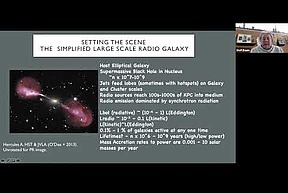
Powerful extragalactic radio sources hosted in galaxies come in
all shapes, sizes, powers, and presumably ages. What might a
young or nascent powerful radio source look like? The class
of compact powerful extragalactic radio sources are defined
to...
We will discuss emergent global symmetries, anomalies, and
dualities in various lattice models and their continuum field
theories. These include the ordinary XY model and some exotic
models related to fractons. We will find that many properties
that...
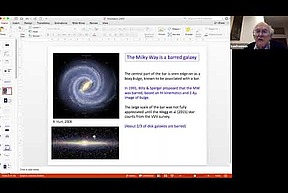
Supported by new observational capabilities, some of our basic
concepts in Milky Way research have changed over the last several
years. Our growing appreciation of the central bar of the Milky
Way, the radial migration of stars, the Galactic thick...
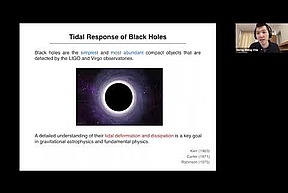
Black holes are never isolated in realistic astrophysical
environments; instead, they are often perturbed by complicated
external tidal fields. How does a black hole respond to these tidal
perturbations? In this talk, I will discuss both the...
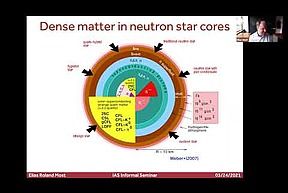
Since the first detection of a gravitational wave event of the
merger of two neutron stars in 2017, two more detections in the
neutron star mass range have been announced. The first one,
GW190425, involved an unusually massive neutron star, the...
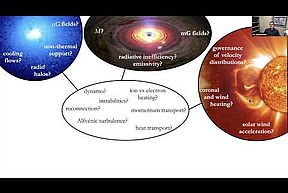
Many space and astrophysical plasmas, such as the solar wind,
radiatively inefficient accretion flows onto black holes, and the
intracluster medium of galaxy clusters (ICM), are hot and dilute,
which makes them weakly collisional or even...
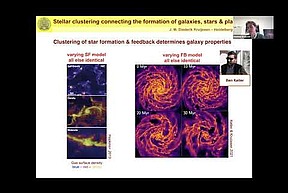
The clustered nature of star formation leaves a long-term
imprint on galaxies, stars, and planets. At young ages, stellar
clustering subdivides galaxies into individual building blocks
undergoing vigorous, feedback-driven life cycles that vary
with...
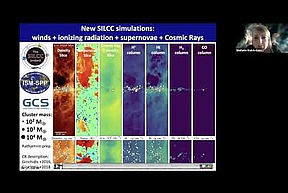
Star formation takes place in the densest and coldest parts of
the interstellar medium (ISM), in dark molecular clouds. These are
swept up by multiple supernova explosions on scales of several
hundred parsec. While condensing out of the warm ISM...