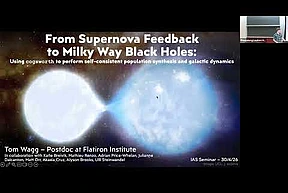
Massive black holes (MBHs) exist at the centers of many dense
star systems, particularly in galactic nuclei. Steady
accretion onto MBHs powers active galactic nuclei, but dynamical
processes near MBHs can generate various forms of transient...
In the era of high-dimensional data and simulation-based
science, machine learning is transforming the different stages of
the scientific method in astrophysics. I will present a summary of
my research connected to generative models in two main...
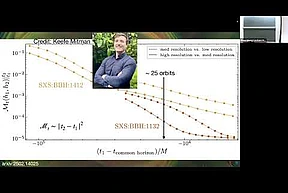
In the past decade, we have detected hundreds of gravitational
waves, advancing our understanding of the Universe and its
governing laws. In this talk, I will present the theoretical models
and data analysis tools I have developed for interfacing...
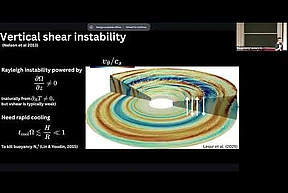
Gas-rich environments are ubiquitous in various scales, from
protoplanetary disks to star clusters and galaxies. Dynamics in
gas-rich environments are substantially different and give rise to
unique astrophysical phenomena, along with enhancing the...
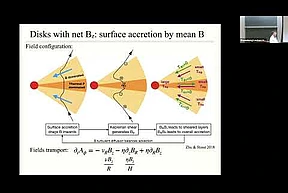
Spatially resolved polarimetric images of black holes with the
Event Horizon Telescope (EHT) favor models with strong magnetic
fields, so-called Magnetically Arrested Disks or MAD models.
MADs can produce efficient jets via the Blandford-Znajek (BZ...
The alpha disk model is widely used to describe the accretion
disk structures around supermassive black holes, even though it
cannot explain many observed properties of AGNs. Various
alternative models have been proposed including the ones
where...
Deep generative models offer powerful tools for solving
astrophysical inference problems by enabling flexible
representations of prior knowledge and likelihood functions.
In the first part of the talk, I will discuss how generative
models can be...
The so-called galaxy--halo connection is a vast topic concerning
how galaxies populate their host dark matter halos. I will
present some works we have made under this grand theme, including
(1) the detection of assembly bias signal with the help of...