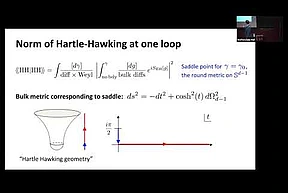
The Schwarzschild-de Sitter solution can be used to compute the
Hartle-Hawking wavefunction of the universe on a spatial circle
times a sphere. Its norm can be evaluated in the semiclassical
limit and compared to the on-shell action of the Euclidean...
The topology of the universe is unknown, and a typical manifold
will contain nontrivial cycles and boundaries. This is quite
consistent with the observed Lambda CDM cosmology, which does not
imply that we live in a closed universe (including...
The one-loop gravitational path integral around Euclidean de
Sitter space S^D has a complex phase that casts doubt on
a state counting interpretation. Recently, it was proposed to
cancel this phase by including an observer. We explore this
proposal...
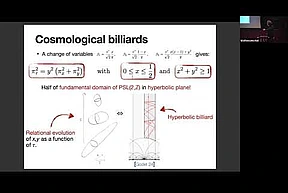
Over 50 years ago, Belinski-Khalatnikov-Lifshitz (BKL) argued
that the dynamics of spacetime close to a space like
singularity is chaotic and inhomogeneous. I will revisit the
BKL scenario within a modern understanding of quantum chaos
and...
The framework of quantum reference frames (QRFs) lies at the
crossroads of quantum information, gauge theory, quantum field
theory, and quantum gravity, and has seen rapid progress in recent
years. After introducing the perspective-neutral...
A simple model of topological gravity can be defined by summing
a 3d TQFT over all bulk topologies. I will explain how this sum is
formulated so as to be holographically dual to a well-defined
boundary ensemble. I will then present several explicit...
In holography, an effective spacetime description emerges from
the fundamental boundary description. But can all spacetime
geometries emerge from a holographic theory? In this talk, I will
argue that in some situations, a region of spacetime can...
Does the gravitational path integral define a valid Hilbert
space for open and closed universes? In this talk, I will review
the positivity criteria that the gravitational path integral has to
satisfy in order for all open and closed universe states...
I will discuss the fate of quantum states in the semiclassical
limit of the AdS/CFT correspondence, focusing on cases where the
gravitational side involves black holes or “baby universes.”
Typically, these states do not converge to simple, pure...
We argue that Euclidean wormhole configurations in
AdS/CFT--central to the factorization problem--originate from the
erratic $N$-dependence that arises in the large-$N$ limit of
conformal field theories (CFTs). We propose that constructing
the...