Astrophysics

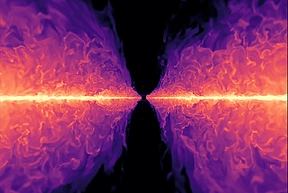
Building on decades of effort, Lizhong Zhang, Member (2023–24) in the School of Natural Sciences; James Stone, Professor in the School; and a team of astrophysicists have achieved a major milestone: developing the most comprehensive model to date of luminous black hole accretion. Their breakthrough allows scholars to "observe" such black hole systems not through a telescope, but through a computer.

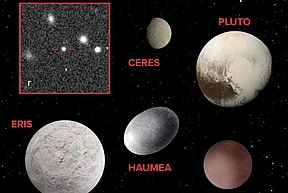
A small team led by Sihao Cheng, Martin A. and Helen Chooljian Member in the School of Natural Sciences, has discovered an extraordinary trans-Neptunian object (TNO) at the edge of our solar system. The TNO is potentially large enough to qualify as a dwarf planet, the same category as the much more well-known Pluto. The discovery has significant implications for our understanding of the Kuiper Belt and hypotheses that surround the existence of Planet Nine.

A small team led by Sihao Cheng, Martin A. and Helen Chooljian Member in the School of Natural Sciences, has discovered an extraordinary trans-Neptunian object (TNO) at the edge of our solar system. The TNO is potentially large enough to qualify as a dwarf planet, the same category as the much more well-known Pluto. The discovery has significant implications for our understanding of the Kuiper Belt and hypotheses that surround the existence of Planet Nine.

This month, an effort to unite three astrophysical research communities who exploit common techniques to understand waves in gaseous disks, galaxies, and stars was made by three scholars from the School of Natural Sciences. John N. Bahcall Fellow Chris Hamilton and Members Callum W. Fairbairn and Uddipan Banik organized a workshop titled IAStrophysical Waves, at which over thirty astrophysicists from across the globe were in attendance.