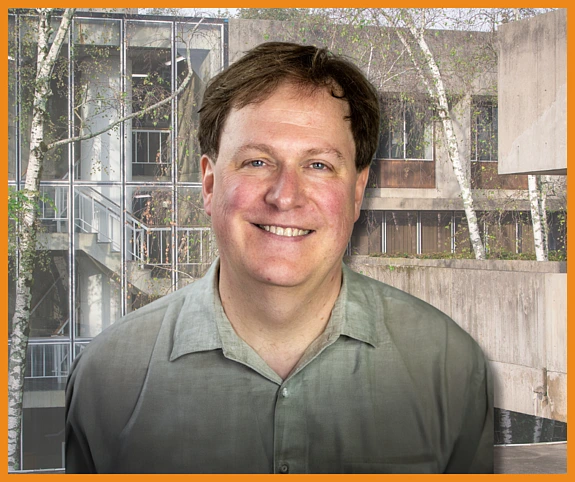
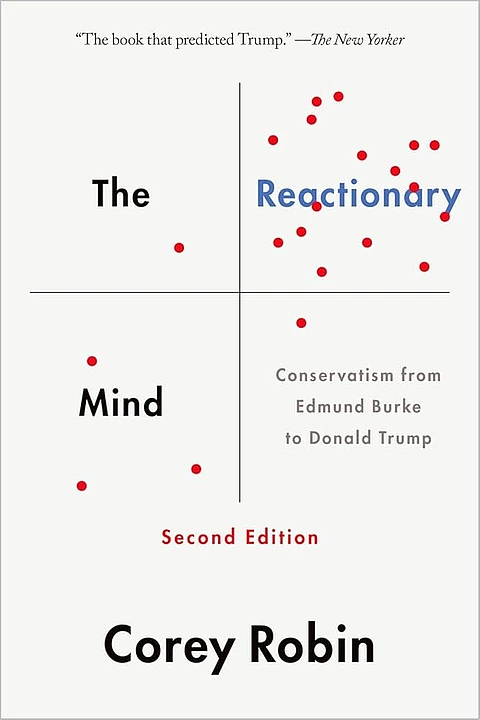
Corey Robin, Member in the School of Social Science, is a political theorist and journalist whose scholarship addresses a range of topics across modern economic and political thought, from the role of fear in the Western imagination to the black nationalist roots of Justice Clarence Thomas’s jurisprudence. He has published landmark work on the history of conservatism, including The Reactionary Mind: Conservatism from Edmund Burke to Donald Trump. He joins the Institute from Brooklyn College and the CUNY Graduate Center, where he is a Distinguished Professor of Political Science.
What will you focus on during your time at IAS?
I'm writing a book called "King Capital." What I'm most interested in is how our ideas of capitalism, particularly economists’ ideas of capitalism, are often ways of describing politics but in an economic language. I'm interested in that translation: of political language into an economic idiom.
One of the inspirations for my project is that what economic actors seek is not reducible to the search for, or accumulation of, profit; it often concerns the acquisition and accumulation of power. So capitalists imagine themselves to be king, in a sense. Joseph Schumpeter once said that the only way, under capitalism, to experience the kind of position that a feudal lord—or an ancient king—would've had is through conquest in the economy.
There's also recently been a lot of discussion about the decline of reading, how people, including students, don't really read full books anymore. As a teacher, I care about this a lot. My hope is that this book—which is going to be published by Random House, so I hope it will be read by more than academics—will also be an argument about what you can derive from reading original texts that you cannot attain in any other way. Even from reading economists, whom we don’t think of as great stylists and great writers. Many of them are.
Are there IAS scholars, past or present, who have impacted or influenced your research?
Definitely Wendy Brown [UPS Foundation Professor in the School of Social Science], who was one of the first people to look at neoliberalism as a political rather than simply an economic form. She certainly is one of the people I think about, and am thinking with, all the time. Before Brown there was Albert O. Hirschman [Professor (1974–2012) in the School of Social Science], who was a great economist here. He wrote a brilliant book in the 1970s called The Passions and the Interests, about the ways in which early modern thinkers and economists thought that capitalism would tame political passions like ambition and heroism and glory. That was a book that created years and volumes of scholarship. It’s a book I’m always thinking with.
In my work now, I'm actually taking the opposite tack: considering not how economics tamed those passions, but how economics reproduces those passions. Lastly, there was another scholar here during the 1970s, Quentin Skinner [Member in the Schools of Historical Studies (1974–75) and Social Science (1976–79)], who is an intellectual historian, another important close reader of texts. So I'd say Brown, Hirshman, and Skinner. There's definitely a strong Institute vibe in this work, which is part of what makes it so exciting to be here.
Is there a surprising job you've held outside of your research?
It's kind of embarrassing, but I shined shoes when I was in ninth grade. My family was so excited that I was doing this. I don't know why exactly. But my father gave me a little shoe-shine box kind of thing, and I went to some place, and I guess the men wanted their shoes shined, so I did that. I was a traveling shoeshiner!
Where is the most unusual place you have ever worked on your research?
There was a period when I used to do all of my reading on the New York City subway system. It was the best way, really. I loved it. I would just ride for hours. I would literally get on the subway to ride and read, because it was the only place where there was no phone reception—or there used to be no reception. And the ambient noise of the train, it was like white noise: it wouldn't bother me. So that was a great time.
If you had to give a seminar on something unrelated to your field, what would it be?
I really enjoy approaching political questions through literature. The politics of marriage, the politics of the family—there are all kinds of elements in novels or in plays that were once considered (for example, in Plato’s Republic or Aristotle’s Politics) political questions. So I really love teaching literature, particularly to literature students. A course I would like to teach would be focused on only the Oresteia, Hamlet, and Beloved—each text is about the family, and about murder in the family, but in very different political moments, with quite different political valences.
Is there a concept in your work you wish more people understood?
I think people who are not economists underestimate how aesthetic and non-scientific economists can be. The great economists never styled themselves as natural scientists or mathematicians at all. Many people don't know that: how much economists were indebted to literary categories, political categories, and social categories. That's probably the thing I would want people to understand—don’t take the scientific self-understanding of economics too seriously. And on the flip side, if you read Jane Austen, she understood economics. George Eliot, too. Adam Smith appears right at the beginning of Middlemarch. It's all there.
Is there something you read or watched over the summer that was memorable, or that you would recommend?
One that really stayed with me is a book called Swansong, by a twentieth-century German writer, Walter Kempowski. He was a fiction writer, but this book is a collection: he gathered tens of thousands of diaries and journals and letters and memoirs from the last days of the Second World War. He picked four dates in the last twenty-five days or so of the war, and he just collected snippets from these memoirs, from Winston Churchill, to a Russian soldier on the front, to a concentration camp survivor, to Edmund Wilson literally eating crows in London. It's this incredible collage of just four days, in maybe 400 pages. It captures the immensity of the Second World War and the variety of individual experiences that were caught up in it. It's stunning.