What happens when a planet plows through the swirling disk of gas and dust that surrounds a young star? Whilst much of the previous research on this subject has focused on planets tracing neat, circular paths, the cosmos is rarely so orderly. In a recent paper, Friends of the Institute for Advanced Study Member Callum W. Fairbairn and NASA Einstein Fellow Alexander Dittmann, both from the School of Natural Sciences, have broadened our understanding of planets on elliptical, or “eccentric,” orbits.
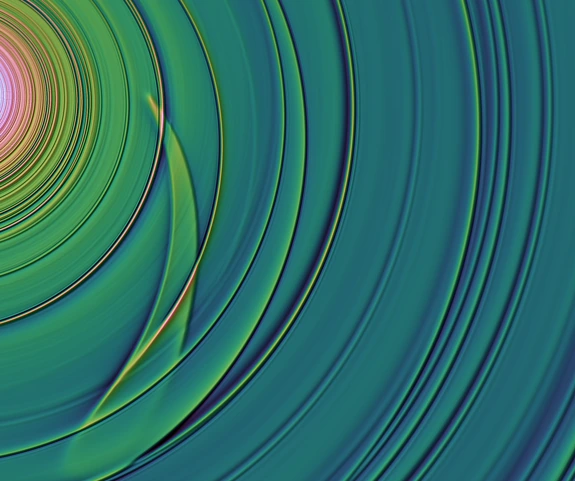
Using state-of-the-art hydrodynamic simulations, Dittmann and Fairbairn tested an analytical “linear theory” previously developed by Fairbairn and frequent IAS Visitor Roman Rafikov. This theory, which predicts mathematically how planets stir up spiral waves of gas in disks, was originally applied to those with small eccentricities. Dittmann and Fairbairn pushed the limits of this theory, exploring planets with highly eccentric orbits, including some that were moving supersonically relative to the disk.
Their findings are striking: even at extreme eccentricities, the linear theory remains robust, accurately capturing the complex push and pull between planet and disk. This is especially significant, as many observed planets—including those in our own solar system—do not follow perfect circles but rather exhibit significant eccentricities.
Beyond validating the linear theory, their work illuminates subtle, nonlinear phenomena. For instance, as planets whip through the disk, the spirals they generate can steepen and form shock waves, changing the disk’s structure. These effects, previously hard to model, are now better under stood thanks to Dittmann and Fairbairn’s detailed comparisons between simulation and theory.
The results not only provide a detailed benchmark for planet-disk interaction problems but also enrich scholars’ knowledge of how planets shape, and are shaped by, their gaseous surroundings .