Roger E. Covey Distinguished Lecture in Pre-Modern China
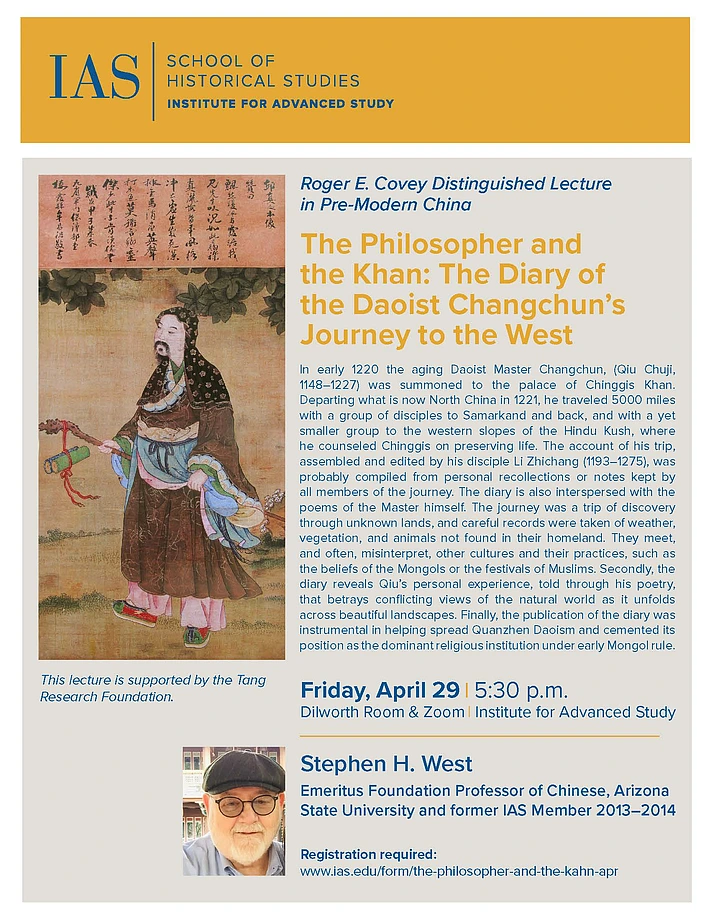
The Philosopher and the Kahn: The Diary of the Daoist Changchun’s Journey to the West
In early 1220 the aging Daoist Master Changchun, (Qiu Chuji, 1148–1227) was summoned to the palace of Chinggis Khan. Departing what is now North China in 1221, he traveled 5000 miles with a group of disciples to Samarkand and back, and with a yet smaller group to the western slopes of the Hindu Kush, where he counseled Chinggis on preserving life. The account of his trip, assembled and edited by his disciple Li Zhichang (1193–1275), was probably compiled from personal recollections or notes kept by all members of the journey. The diary is also interspersed with the poems of the Master himself. The journey was a trip of discovery through unknown lands, and careful records were taken of weather, vegetation, and animals not found in their homeland. They meet, and often, misinterpret, other cultures and their practices, such as the beliefs of the Mongols or the festivals of Muslims. Secondly, the diary reveals Qiu’s personal experience, told through his poetry, that betrays conflicting views of the natural world as it unfolds across beautiful landscapes. Finally, the publication of the diary was instrumental in helping spread Quanzhen Daoism and cemented its position as the dominant religious institution under early Mongol rule.
Stephen H. West | Emeritus Foundation Professor of Chinese, Arizona State University and former IAS Member 2013-2014
This lecture is supported by the Tang Research Foundation.