Quantum, Broadly Considered–December 4, 2025
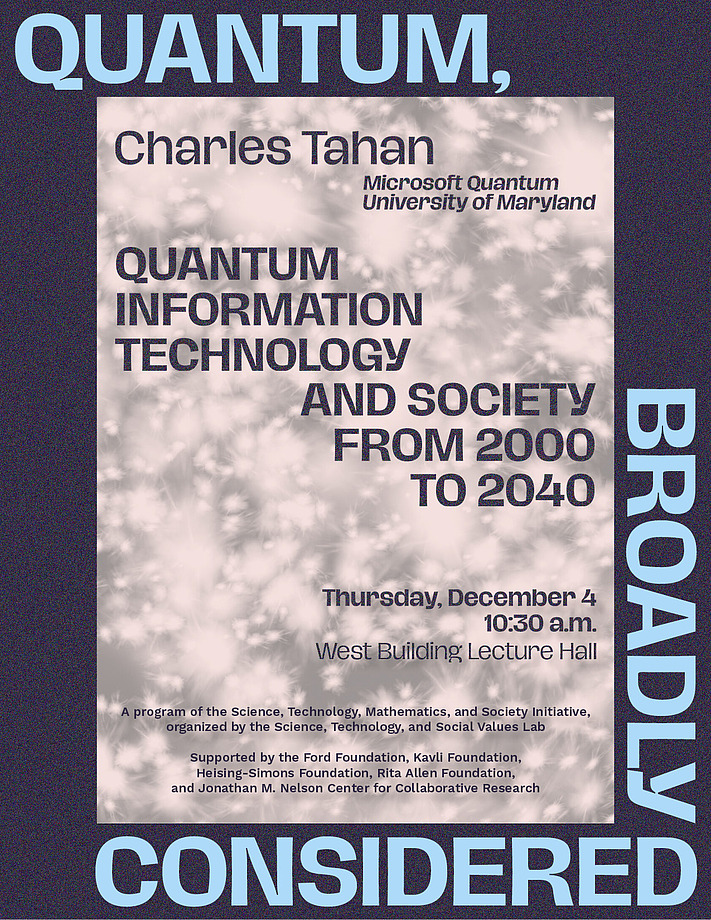
QUANTUM, BROADLY CONSIDERED Speaker Series
Charles Tahan, Microsoft Quantum
Thursday, December 4, 2025
10:30 a.m.
West Building | Lecture Hall
"Quantum Information Technology and Society from 2000 to 2040”
In what ways do unresolved questions in physics and mathematics shape the possibilities of quantum research? What can the history of semiconductors teach us about the future of quantum research? How do government investments shape research priorities? And what happens when scientific breakthroughs encounter markets?
During the 2025–2026 academic year, the Institute’s four Schools will collaboratively host a speaker series examining these questions through multidisciplinary perspectives, including at the intersection of quantum science, mathematics, technology policy, and the history of science.
This Institute-wide initiative seeks to foster scholarly dialogue on the present moment in quantum research, a moment defined by both deep theoretical uncertainty and intensifying strategic interest. Scientific and technical challenges remain formidable, even as government investment and private-sector activity create new incentives and new pressures for development. Commercial applications are still largely speculative. The predominant focus on quantum computing may also overshadow nearer-term breakthroughs in sensing, communication, and scientific instrumentation, while critical questions endure about viability, scaling, and broader social impact. These dynamics make this an opportune moment for scholarly examination of the fields' epistemic assumptions, institutional contexts, and possible futures.
On December 4, 2025, IAS will host Dr. Charles Tahan, who will present, "Quantum Information Technology and Society from 2000 to 2040.” The lecture will take place in the West Building Lecture Hall at 10:30 a.m.
Charles Tahan is a policy advisor and physicist specializing in condensed matter physics and quantum information science and technology. He currently leads a technical team at Microsoft Quantum and is also a visiting research professor of physics at the University of Maryland. He formerly served as Assistant Director for Quantum Information Science (QIS) within the White House Office of Science and Technology Policy and as Director of the National Quantum Coordination Office, which ensures coordination of the National Quantum Initiative and QIS activities across the federal government, industry, and academia. From 2005–2007, he was a National Science Foundation Distinguished International Postdoctoral Research Fellow at the University of Cambridge, UK; the Center for Quantum Computing Technology, Australia; and the University of Tokyo, Japan. A Fellow of the American Physical Society, Dr. Tahan earned a Ph.D. in Physics at the University of Wisconsin-Madison.
Suggested Readings:
Tahan, Charles. "Opinion: Democratizing Spin Qubits." Quantum, vol. 5, Nov. 2021, p. 584, arXiv:2001.08251v2.
---. "Opinion: The Simplest Quantum Computer (A Retrospective from 2040)." arXiv, 2024, https://doi.org/10.48550/arXiv.2412.18726.
---. "Spookytechnology and Society." arXiv, 2007, https://arxiv.org/pdf/0710.2537.
White House Office of Science and Technology Policy. National Quantum Initiative Strategy Reports. 2021-2025, https://www.quantum.gov/strategy/#STRATEGY-DOCUMENTS.
QUANTUM, BROADLY CONSIDERED is a speaker series organized by the Science, Technology, and Social Values Lab, under the direction of Harold F. Linder Professor Alondra Nelson. This speaker series is a program of the Science, Technology, Mathematics, and Society Initiative, which was established in 2021 by James D. Wolfensohn Professor Didier Fassin, Hermann Weyl Professor Helmut Hofer, Albers-Schönberg Professor in the History of Science Myles W. Jackson, Charles Simonyi Professor Nathan Seiberg, and Robert & Luisa Fernholz Professor Akshay Venkatesh to foster dialogue across the Institute's Schools.
Supported by the Ford Foundation, Kavli Foundation, Heising-Simons Foundation, Rita Allen Foundation, and the Jonathan M. Nelson Center for Collaborative Research.