Special Workshop Honoring Jim Simons
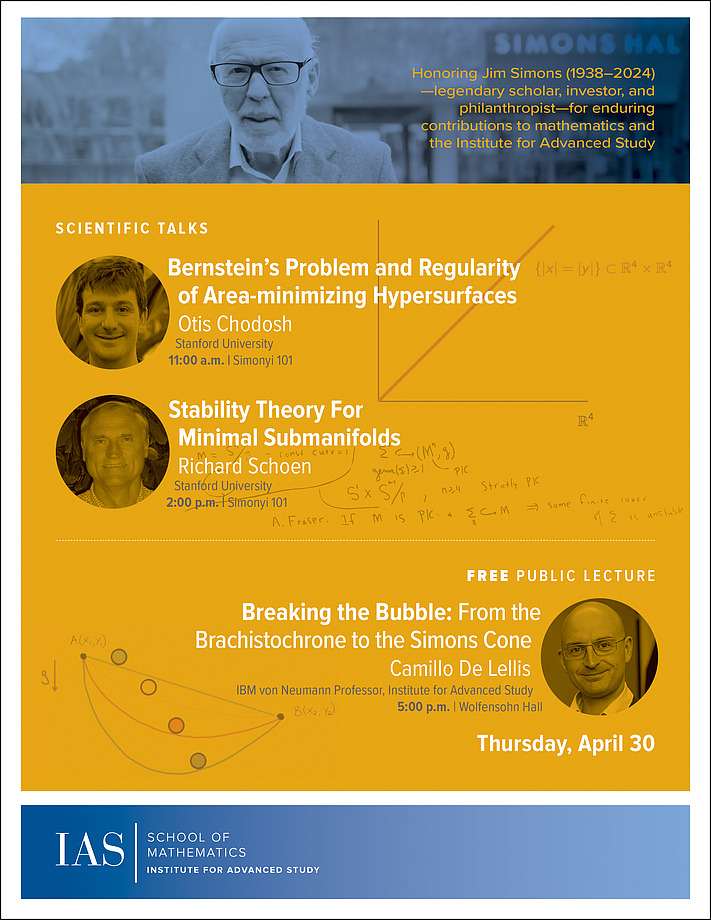
Special Workshop Honoring Jim Simons
Thursday, April 30, 2026
SCIENTIFIC TALKS
Simonyi Hall 101 | 11:00 a.m.
Otis Chodosh, Stanford University
Bernstein’s Problem and Regularity of Area-minimizing Hypersurfaces
Chodosh will describe some old and new work related to Jim Simons’ seminal paper “Minimal varieties in Riemannian manifolds.” In particular, he will describe the relation to Bernstein’s problem on minimal graphs as well as partial/generic regularity of area-minimizing hypersurfaces.
Simonyi Hall 101 | 2:00 p.m.
Richard Schoen, Stanford University
Stability Theory for Minimal Submanifolds
While the most dramatic and direct consequence of the 1968 paper by Jim Simons concerned the regularity of area minimizing hypersurfaces, it also introduced a systematic study of the second variation of volume and used it to show the instability of low dimensional minimal cones. Stable minimal submanifolds (and those of bounded Morse index) form a class between the stationary and area minimizers, and it is of great interest to understand their geometric and analytic properties. There has been a robust theory developed in codimension one, but much less is known in higher codimension. We will survey this theory and some of its applications to Riemannian geometry and describe some current directions.
PUBLIC LECTURE
Wolfensohn Hall | 5:00 p.m.
Camillo De Lellis, IBM von Neumann Professor, Institute for Advanced Study
Breaking the Bubble: From the Brachistochrone to the Simons Cone
From the fastest path down a ramp to the form of a soap film, the quest to find nature's most efficient shapes has driven centuries of mathematical discovery. This lecture will trace the history of the calculus of variations, translating its most important concepts into everyday terms. The journey culminates with Jim Simons' groundbreaking paper on minimal cones, which showed that the familiar physical rules of everyday bubbles dramatically break down in higher dimensions and paved the way for the ultimate resolution of a decades-old mathematical mystery.
To register for the public lecture, click HERE.