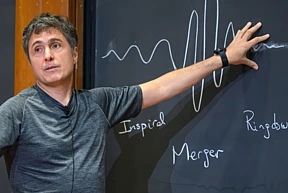
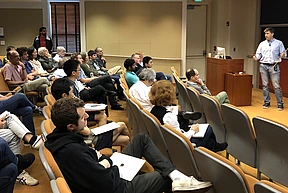
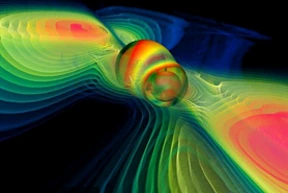
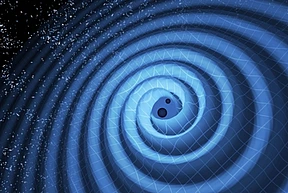
When massive objects like black holes move through the universe, they create gravitational waves—ripples in the very fabric of spacetime. This summer, IAS became a hub for exploring this rapidly evolving field as the 2025 Prospects in Theoretical Physics (PiTP) program welcomed 85 attendees for an intensive workshop focused on gravitational wave physics and astrophysics.
In an article for Quanta, Isabel Garcia Garcia, past Member in the School of Natural Sciences (2022–23), discusses the latent possibilities of LISA, the first dedicated space-based gravitational wave observatory, currently scheduled to launch in the 2030s.
Scholars at the Institute for Advanced Study (IAS) recently
submitted a
paper announcing the discovery of six new binary black hole
mergers that exceed the detection thresholds defined by the
LIGO-Virgo Collaboration (LVC), the group responsible for...
Gravitational waves were detected for the first time a year and
a half ago, when some of them throbbed through Earth. Two
incredibly sensitive detectors—one in Washington State and one in
Louisiana—picked up the distortions in spacetime, emanating...
Confronted with a theoretical question, such as whether or not
gravitational waves exist, Richard Feynman never trusted
authorities. Rather, he tried to develop and convince himself of a
solution in the simplest way possible, constructing an...
Scientists who in February announced their landmark discovery of
these ripples in spacetime revealed today that they had detected
more—again caused by a pair of crashing black holes. This second
find shows that the initial discovery was not a rare...
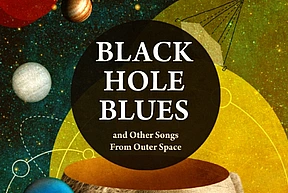
In Black Hole Blues: And Other Songs From Outer Space
the astrophysicist and novelist Janna Levin chronicles the
decades-long development of a machine that could detect
gravitational waves—a quest marked by the highest degree of human
intelligence...