Ray Monk to Lecture on Robert Oppenheimer at Institute for Advanced Study
PRESS CONTACT: Katherine Belyi, (609) 951-4406
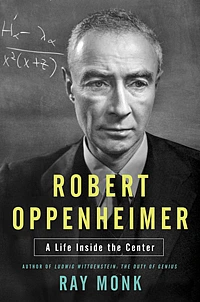
In a public lecture at the Institute for Advanced Study, Ray Monk, the author of a new biography of J. Robert Oppenheimer, will tell the story of the Institute’s third Director in the context of the momentous developments in which he played a leading part. The lecture, “Robert Oppenheimer: A Life Inside the Center” will take place Wednesday, May 15, at 5:00 p.m. in Wolfensohn Hall.
Oppenheimer served as Director of the Institute from 1947 until 1966, the longest tenure of any Institute Director to date. The lecture will give an account of the German Jewish community in New York in which Oppenheimer was brought up, describe his progress as a student, his development as a physicist, his involvement in the left-wing politics in the 1930s and his unlikely choice as director of the laboratory in Los Alamos that produced the world’s first atomic bomb. It will also describe his attempts after the war to secure international control over atomic energy, his opposition to the hydrogen bomb and the security hearing of 1954 that stripped him of his security clearance. As the lecture will show, however, by the time he died in 1967 his reputation—as a scientist, a statesman and a loyal U.S. citizen—had been well and truly re-established.
Monk, a Professor of Philosophy at the University of Southampton, is also the author of Ludwig Wittgenstein: The Duty of Genius (Free Press, 1990), for which he was awarded the John Llewellyn Rhys Prize and the Duff Cooper Prize, and a two-volume biography of Bertrand Russell.
For further information about the lecture, which is free and open to the public, visit the Institute website, www.ias.edu.
About the Institute for Advanced Study
The Institute for Advanced Study is one of the world’s leading centers for theoretical research and intellectual inquiry. The Institute exists to encourage and support curiosity-driven research in the sciences and humanities—the original, often speculative thinking that produces advances in knowledge that change the way we understand the world. Work at the Institute takes place in four Schools: Historical Studies, Mathematics, Natural Sciences and Social Science. It provides for the mentoring of scholars by a permanent Faculty of approximately 30, and it ensures the freedom to undertake research that will make significant contributions in any of the broad range of fields in the sciences and humanities studied at the Institute.
The Institute, founded in 1930, is a private, independent academic institution located in Princeton, New Jersey. Its more than 6,000 former Members hold positions of intellectual and scientific leadership throughout the academic world. Thirty-three Nobel Laureates and 40 out of 56 Fields Medalists, as well as many winners of the Wolf and MacArthur prizes, have been affiliated with the Institute.