Phillip a. Griffiths To Step Down As Director Of Institute For Advanced Study
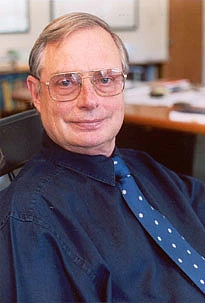
James D. Wolfensohn, Chairman of the Board of Trustees of the Institute for Advanced Study, announced today that Institute Director Phillip A. Griffiths had expressed his intention to step down as Director at the end of the 2002-2003 academic year, and that the Institute is beginning the search for a new Director. Institute Board Member Martin L. Leibowitz, Vice Chairman and Chief Investment Officer of TIAA-CREF, will chair the search committee.
“Phillip has been an exceptionally effective Director of the Institute since 1991,” stated Mr. Wolfensohn, “and he will be greatly missed. We all have enormous respect for him personally and for his accomplishments. His tenure has been marked both by his ability to guide this institution in productive and exciting new directions, and his ability to further strengthen the unique opportunities the Institute offers to scholars from all over the world.”
Dr. Griffiths, an active mathematician whose area of interest is algebraic geometry, will join the Faculty of the Institute’s School of Mathematics when he has concluded his term as Director. As Chairman of the Science Institutes Group, he also will continue to lead the Millennium Science Initiative (MSI), whose primary goal is to create and nurture world-class science and scientific talent in the developing world. In addition, he will continue to serve as a special advisor to the Mellon Foundation, where he will oversee two new fellowship programs.
"The Institute is a better place because of Phillip's years as Director," commented Leon Levy, Chair of the Executive Committee of the Institute's Board of Trustees, "and in my opinion," he continued, "Phillip's leadership has been unsurpassed. Collectively, we wish that he could remain as Director, but we do understand the strength of the other opportunities that await him and will continue to involve him in international academic and scientific pursuits."
During Dr. Griffiths’ directorship the Institute has begun several major initiatives, including new programs in the areas of Asian studies, theoretical computer science, and theoretical biology, as well as the resumption of work in economics. New academic outreach and mentoring programs include the IAS/Park City Mathematics Institute and the Program in Theoretical Physics. Dr. Griffiths oversaw the successful completion of a long-term project to permanently preserve 589 acres of Institute woods and farmlands, and also started an Artist-in-Residence program that has been a great success not only at the Institute, but also in the larger Princeton community.
During Dr. Griffiths’ tenure the Institute campus saw the addition of three new buildings: Simonyi Hall, the home of the School of Mathematics; Wolfensohn Hall, the Institute’s auditorium and site of its concert series; and Bloomberg Hall, the home of the physicists and astrophysicists in the Institute’s School of Natural Sciences. Dr. Griffiths oversaw the expansion and improvement of services to the Institute’s visiting scholars, called Members; Crossroads Nursery School was expanded to include full-time daycare for infants and toddlers; a fitness center was built; and major renovation of the 160 apartments that house Members was completed in 2001.
While serving as Director of the Institute, Dr. Griffiths also taught graduate mathematics courses pro bono at Princeton University and served as dissertation advisor for eight graduate students working towards Ph.D. degrees in mathematics. The author of two books in his field and the co-author of six, Dr. Griffiths is the co-author of two additional books that will be published shortly. He is also the author or co-author of 106 published articles, with four additional articles forthcoming.
Dr. Griffiths served as a key figure in the creation in 1998 of the Millennium Science Initiative (MSI). MSI works to strengthen the science and technology capacity of developing nations through integrated projects of research and training planned and driven by local scientists. Currently, initiatives in Chile, Brazil, and Mexico are underway, and initiatives are being planned in sub-Saharan Africa and Vietnam.
During his early years as Director of the Institute for Advanced Study, Dr. Griffiths was a member of the National Science Board. He also served as the chair of COSEPUP (the Committee on Science, Engineering, and Public Policy), which is a joint unit of the National Academy of Sciences, the National Academy of Engineering, and the Institute of Medicine. Its primary role is to coordinate studies, conducted by special interdisciplinary panels comprising the nation's best scientific and engineering expertise, on cross-cutting issues in science and technology policy.
Phillip A. Griffiths, Ph.D. became the seventh Director of the Institute for Advanced Study in 1991. Prior to joining the Institute for Advanced Study, he was Provost and James B. Duke Professor of Mathematics at Duke University for eight years. From 1972-83 he was a Professor of Mathematics at Harvard University. He has also taught at Princeton University and the University of California, Berkeley. He was a Member in the School of Mathematics at the Institute for Advanced Study from 1968-70.
A native of Raleigh, North Carolina, Dr. Griffiths received his Ph.D. from Princeton University. Among his professional associations, he is a member of the National Academy of Sciences and the American Philosophical Society. Dr. Griffiths is Secretary of the International Mathematical Union. A former member of the Board of Directors of Bankers Trust New York Corporation, he currently serves on the Board of Directors of the Oppenheimer Funds and of GSI Lumonics.
The Institute for Advanced Study, located on an 800-acre site in Princeton, New Jersey, is an independent, private institution whose mission is to support advanced scholarship and fundamental research in historical studies, mathematics, natural sciences, and social science. Founded in 1930, the Institute attracts some of the world’s most renowned scientists and scholars, including numerous Nobel laureates, recipients of the Wolf and MacArthur prizes, and winners of the Fields Medal. Perhaps its best-known Faculty member was Albert Einstein, an Institute Faculty member from 1933-1955.