Owen Fiss to Discuss Telephone Privacy and the Constitution at Institute for Advanced Study
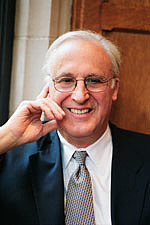
Owen M. Fiss, Sterling Professor Emeritus of Law and Professorial Lecturer in Law at Yale Law School, will examine the state of constitutional rules protecting the privacy of telephone conversations in “The Lives of Others,” a public lecture on Wednesday, December 5, at 5:00 p.m. in Wolfensohn Hall on the Institute campus.
The constitutional rules protecting the privacy of telephone conversations were first announced by the Supreme Court in 1967 and then extended in 1972. Now they are greatly weakened, in part because of a general retrenchment of privacy rights that began in the mid-1970s and continues to this day. This turn of events is also linked to the events of September 11, 2001, which turned the fight against international terrorism into an urgent public issue and, Fiss argues, led to the compromise of fundamental principles of our constitutional order.
The talk is part of Lectures on Public Policy, an annual series at the Institute that addresses issues of broad import relevant to contemporary politics, social conditions and scientific matters.
Fiss received his undergraduate education at Dartmouth College and the University of Oxford and earned his law degree at Harvard Law School. He clerked for Thurgood Marshall, when Marshall was a judge on the United States Court of Appeals for the Second Circuit, as well as William J. Brennan Jr. on the United States Supreme Court. He also served in the Civil Rights Division of the United States Department of Justice. He taught at the University of Chicago from 1968–74 prior to coming to Yale University, where he teaches procedure, legal theory and constitutional law and directs Law School programs in Latin America and the Middle East.
Fiss is the author of many articles and books, including more recently A Way Out: Americas Ghettos and the Legacy of Racism (Princeton University Press, 2003); The Law as It Could Be (New York University Press, 2003); and The Dictates of Justice: Essays on Law and Human Rights (Republic of Letters, 2011). He has received honorary doctorates from the University of Toronto, Universidad de Buenos Aires and Universidad de Palermo, Buenos Aires, and was awarded La Distinción Sócrates from Universidad de Los Andes, Bogotá.
For further information about public events at the Institute, visit www.ias.edu/news/public-events. Past Lectures in Public Policy may be viewed online at https://www.ias.edu/video/public-policy-lectures.
About the Institute for Advanced Study
The Institute for Advanced Study is one of the world’s leading centers for theoretical research and intellectual inquiry. The Institute exists to encourage and support curiosity-driven research in the sciences and humanities—the original, often speculative thinking that produces advances in knowledge that change the way we understand the world. Work at the Institute takes place in four Schools: Historical Studies, Mathematics, Natural Sciences and Social Science. It provides for the mentoring of scholars by a permanent Faculty of approximately 30, and it ensures the freedom to undertake research that will make significant contributions in any of the broad range of fields in the sciences and humanities studied at the Institute.
The Institute, founded in 1930, is a private, independent academic institution located in Princeton, New Jersey. Its more than 6,000 former Members hold positions of intellectual and scientific leadership throughout the academic world. Thirty-three Nobel Laureates and 40 out of 56 Fields Medalists, as well as many winners of the Wolf and MacArthur prizes, have been affiliated with the Institute.