Nima Arkani-Hamed to Discuss the Higgs Boson and Its Paradoxes in Lecture at Institute for Advanced Study
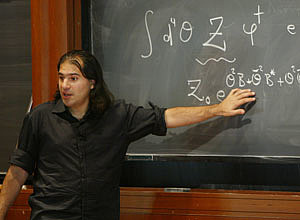
Nima Arkani-Hamed, Professor in the School of Natural Sciences at the Institute for Advanced Study, had long offered to bet a year’s salary that the Higgs boson, the only missing piece of the Standard Model of particle physics, would be found. In the early hours of July 4, he hosted a celebration at the Institute as researchers in Switzerland announced that a particle consistent with the Higgs boson had been observed. On Friday, October 26, Arkani-Hamed will give a public lecture, “The Inevitability of Physical Laws: Why the Higgs Has to Exist,” explaining the principles behind the Higgs boson as well as the new mysteries its discovery opens up. The lecture will take place at 5:30 p.m. in Wolfensohn Hall on the Institute campus.
The principles of relativity and quantum mechanics place powerful constraints on the structure of physical laws. With these principles alone, it is possible to understand the broad features of why the world around us is the way it is, consisting of matter, made of particles like electrons and quarks, interacting with forces, like gravity, electromagnetism and strong and weak nuclear forces. Our present framework for physics is so tightly woven that it is very difficult to modify it without destroying its successful properties. This provides a strong check on theoretical speculations and helps guide us to a small set of candidates for new laws.
In this talk, Arkani-Hamed will illustrate these ideas in action by explaining why theoretical physicists knew the Higgs boson had to exist long before it was discovered at the Large Hadron Collider last July. While the discovery of the Higgs is a triumph for both experimental and theoretical physics, its existence opens up a set of profound conceptual paradoxes, whose resolution is likely to involve radical new ideas. The talk will conclude with a description of some possible avenues of attack on these mysteries, and what we might learn about them from the LHC in this decade.
Much of Arkani-Hamed’s work as a particle physics phenomenologist is concerned with the relation between theory and experiment, and he has taken a leading role in proposing new physical theories that can be tested at the LHC. His research has shown how the extreme weakness of gravity, relative to other forces of nature, might be explained by the existence of large extra dimensions of space, opening up the possibility that quantum gravitational effects can be probed at accelerators and even in table-top experiments. More recently, he has explored how the structure of low-energy physics is constrained within the context of string theory.
In July, Arkani-Hamed was one of four members of the School of Natural Sciences Faculty to receive the inaugural Fundamental Physics Prize, with an award of $3 million each, honoring path-breaking ideas in fundamental physics. Arkani-Hamed is also the recipient of the Gribov Medal and the Raymond and Beverly Sackler Prize in Physics, among other honors.
Arkani-Hamed received his Ph.D. in 1997 from the University of California, Berkeley, where he then worked as a postdoctoral fellow at the SLAC National Accelerator Laboratory. He became an Assistant and then an Associate Professor at Berkeley before moving to Harvard University in 2002 as a Professor. In 2008, he joined the Faculty of the Institute for Advanced Study.
For further information about public events at the Institute visit www.ias.edu/news/public-events.
About the Institute for Advanced Study
The Institute for Advanced Study is one of the world’s leading centers for theoretical research and intellectual inquiry. The Institute exists to encourage and support curiosity-driven research in the sciences and humanities—the original, often speculative thinking that produces advances in knowledge that change the way we understand the world. Work at the Institute takes place in four Schools: Historical Studies, Mathematics, Natural Sciences and Social Science. It provides for the mentoring of scholars by a permanent Faculty of approximately 30, and it ensures the freedom to undertake research that will make significant contributions in any of the broad range of fields in the sciences and humanities studied at the Institute.
The Institute, founded in 1930, is a private, independent academic institution located in Princeton, New Jersey. Its more than 6,000 former Members hold positions of intellectual and scientific leadership throughout the academic world. Thirty-three Nobel Laureates and 40 out of 56 Fields Medalists, as well as many winners of the Wolf and MacArthur prizes, have been affiliated with the Institute.