The Historian's Craft Today is Subject of Lecture by Carlo Ginzburg at Institute for Advanced Study
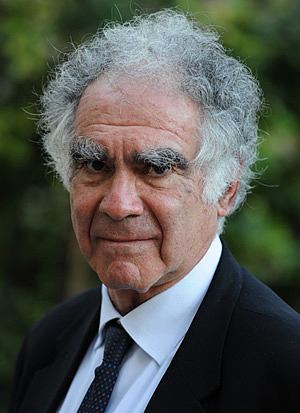
Carlo Ginzburg, Professor Emeritus at the University of California, Los Angeles, will present “Our Words, and Theirs: A Reflection on the Historian’s Craft Today” on Monday, October 3, at 4:30 p.m. in Wolfensohn Hall on the Institute campus.
A pioneer of microhistory, Ginzburg is best known for his 1976 book The Cheese and the Worms: The Cosmos of a Sixteenth-Century Miller, which examines the beliefs of an Italian heretic. Born in Turin, Italy, Ginzburg has made critical contributions to art history, literary studies, and the theory of historiography in the Italian Renaissance and early modern European history.
In this lecture, Ginzburg will ask, What is the relationship between the idiom of the observer (historian, anthropologist) and the idiom of the actors, dead or alive? The question provides an oblique approach to the cognitive, moral and political implications of the historian’s craft today. Ginzburg will explore the question, which has been addressed from widely different (and usually unrelated) points of view.
Ginzburg was awarded the 2010 Balzan Prize for European History, 1400-1700, and was cited for the “exceptional combination of imagination, scholarly precision and literary skill with which he has recovered and illuminated the beliefs of ordinary people in Early-modern Europe.”
His other books include The Judge and the Historian. Marginal Notes on a Late-Twentieth-century Miscarriage of Justice (Verso, 2002); No Island is an Island. Four Glances at English Literature in a World Perspective (Columbia University Press, 2000); Ecstasies. Deciphering the Witches’ Sabbath (Pantheon, 1991); and Clues, Myths and the Historical Method (Johns Hopkins University Press, 1989).
For further information about the lecture, which is free and open to the public, please call (609) 734-8175, or visit the Public Events page on the Institute website, www.ias.edu.
About the Institute for Advanced Study
The Institute for Advanced Study is one of the world’s leading centers for theoretical research and intellectual inquiry. The Institute exists to encourage and support curiosity-driven research in the sciences and humanities—the original, often speculative thinking that produces advances in knowledge that change the way we understand the world. Work at the Institute takes place in four Schools: Historical Studies, Mathematics, Natural Sciences and Social Science. It provides for the mentoring of scholars by a permanent Faculty of approximately 30, and it ensures the freedom to undertake research that will make significant contributions in any of the broad range of fields in the sciences and humanities studied at the Institute.
The Institute, founded in 1930, is a private, independent academic institution located in Princeton, New Jersey. Its more than 6,000 former Members hold positions of intellectual and scientific leadership throughout the academic world. Thirty-three Nobel Laureates and 40 out of 56 Fields Medalists, as well as many winners of the Wolf and MacArthur prizes, have been affiliated with the Institute.