Four Public Lectures Offered At Institute For Advanced Study
The Institute for Advanced Study will present a series of free public lectures on April 4 and 5, all to take place in Wolfensohn Hall on the Institute campus.
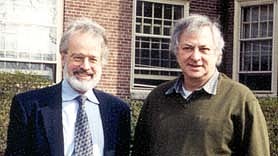
Jean Bourgain, professor in the School of Mathematics, will speak on Friday, April 4 at 4:30 p.m. His topic will be “A Journey in the World of Differential Equations.” “Mathematics is driven by both internal and eternal motivations,” says Bourgain. “These have to do with the history of the subject and its constant solicitation by new problems. This is especially the case in the realm of differential equations,” where “Some of the oldest challenges here go back to celestial mechanics.” Bourgain plans “to explore some of the background and recent developments,” in the field, including the “somewhat controversial role of computers in the practice of pure mathematics.”
Bourgain earned his Ph.D. from the Free University of Brussels, Belgium. After professorships at the Free University, the University of Illinois, Hebrew University of Jerusalem, and California Institute of Technology, as well as 10 years at the Institut des Hautes Etudes Scientifiques in France, he joined the faculty of the Institute for Advanced Study in 1994.
In 1994 Bourgain received the Fields Medal – officially known as the International Medal for Outstanding Discoveries in Mathematics. The award honored his achievements in several fields: advances in the study of subspaces of Banach spaces that resemble Hilbert subspaces, a proof of Luis Antonio Santalo’s inequality, a new approach to some problems in ergodic theory, results in harmonic analysis and classical operators, and nonlinear partial differential equations.
Three further lectures will take place on Saturday, April 5.
“Human Dissection and Vivisection: Science, Religion, and Politics in Ancient Greece” will be the topic addressed by Heinrich von Staden, professor in the School of Historical Studies. His talk is scheduled for 9:15 a.m.
Von Staden says, “In the third century B.C.E. two Greek physicians, Herophilus and Erasistratus, became the first ancients to perform systematic dissections of human cadavers, and to conduct vivisectory experiments on condemned criminals.” Their discoveries revolutionized Western conceptions of the body, says von Staden, “yet their methods of discovery were quickly abandoned. The uniqueness of their activities within the history of ancient science and medicine presents a series of challenging historical puzzles that can in part be resolved by exploring some of the religious, political, and scientific conditions under which those two pioneers conducted their research.”
Von Staden, a classicist and authority on ancient medicine and biology, joined the permanent Institute faculty in 1998. Previously, he was William Lampson Professor of Classics and Comparative Literature at Yale University, where he had been a faculty member since 1968. He has also taught at the New School for Social Research in New York City. A graduate of Yale, he earned his Ph.D. at Universit�t T�bingen in Germany.
Von Staden is a member of the American Philosophical Society and a corresponding member of several foreign academies of the arts and sciences. His publications include a prize-winning book on medicine in ancient Alexandria, and more than a hundred articles on ancient medicine, biology, and philosophy.
At 11:15 a.m., Diana Kormos-Buchwald, Director and General Editor of The Einstein Papers, and Associate Professor of History at California Institute of Technology, will speak on “Einstein’s Legacy: A Quarter Century of The Collected Papers of Albert Einstein.”
She will speak about the history of the Einstein Papers project, which she calls “one of the most ambitious publication efforts in the history of science.” Drawing upon more than 50,000 Einstein and Einstein-related documents, the Papers document the life and work of “the most influential 20th-century scientist.” The talk will also “touch upon Einstein's scientific legacy, his enduring impact on physics research, his two decades at the Institute for Advanced Study, and his educational and humanitarian efforts.”
Kormos-Buchwald earned her bachelor’s degree at Technion Institute, Haifa, and her Ph.D. in the history of science at Harvard University. She was a member in the Institute’s School of Social Science in 1992-93. On the CalTech faculty since 1990, she assumed directorship of the Papers project in 2000.
She has received grants from the Sloan Foundation, the Beckman Foundation, the National Endowment for the Humanities, and the National Science Foundation. She is a participant in an international inter-university project funded by a Sloan/Dibner grant, “The History of Recent Science on the Web.”
Molecular biologist Arnold Levine, visiting professor in the School of Natural Sciences, will speak on “The Human Genome Project: Where Do We Go From Here?” at 2:00 p.m.
“The sequence of the human genome is now completed, and has given us new insights into human evolution, disease processes, and biological functions,” observes Levine. “We now have a fairly complete parts manual, and the challenges are to decipher the regulatory signals in our genes that control the timing, positions, and levels of activity of each gene.”
The genetic differences among us have enhanced the explanation of human genetics and our understanding of diseases,” topics that Levine will explore and discuss.
Levine, a graduate of the State University of New York, received his Ph.D. from the University of Pennsylvania School of Medicine. Before coming to the Institute, he was President and Chief Executive Officer of the Rockefeller University in New York City. On the faculty of Princeton University from 1968 to1979, he chaired the Department of Microbiology at the State University of New York at Stony Brook School of Medicine until 1983, when he returned to Princeton as Weiss Professor in the Life Sciences and Chair of the Department of Molecular Biology.
A member of the National Academy of Sciences, his numerous honors include, most recently, the Memorial Sloan Kettering Cancer Center Medal for Outstanding Contributions to Biomedical Research, the Keio Medical Science Prize from Keio University in Japan, and the Knudson Award in Cancer Genetics from the National Cancer Institute.
The lectures are sponsored by the Association of Members of the Institute for Advanced Study, an organization composed of former visiting scholars at the Institute. For further information, call (609) 734-8259.