Charles Simonyi Discusses Space Travel in Talk at Institute for Advanced Study
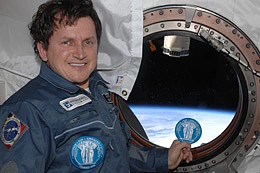
Very few civilians have a chance to participate in space travel, and for the lucky few, it is a once-in-a-lifetime experience—except for Charles Simonyi, Chairman of the Board of Trustees of the Institute for Advanced Study and President and CEO of Intentional Software Corporation, the first and only “space tourist” to fly twice. Simonyi will discuss his “Return to Space” on Thursday, May 6, at 4:30 p.m. in Wolfensohn Hall on the Institute’s campus.
Simonyi’s first trip was in 2007 and his most recent trip was in 2009, for a combined total of twenty-eight days in space. Both times, he traveled in a Russian-built Soyuz spacecraft to visit the International Space Station. In his talk, Simonyi will discuss daily life in a spacecraft and on the International Space Station, and will show footage of his 2009 dynamic return trip from orbit to the ground in Kazakhstan. This presentation is intended for a general audience, and children aged nine and older are encouraged to attend.
A Trustee of the Institute since 1997, Simonyi became Chairman of the Institute’s Board of Trustees in October 2008, having served as President of the Corporation from 2003-08. Simonyi’s involvement with the Institute began in 1996, and over the years, he has supported a range of academic activities, including endowing the Charles Simonyi Professorship in Theoretical Physics in the Institute's School of Natural Sciences, currently held by Edward Witten. Simonyi has also provided substantial funding for the Institute's School of Mathematics, helping to ensure the School’s financial independence to select the very best Members, many from abroad. Simonyi Hall, which houses the School of Mathematics, was dedicated in May 2000 in recognition of Simonyi's participation in the life of the Institute community and his commitment to the work that takes place here.
Simonyi was born in Hungary. He earned a B.S. in engineering and mathematics from the University of California, Berkeley, in 1972, and his Ph.D. in computer science from Stanford University in 1977. He worked at the renowned Xerox Palo Alto Research Center (PARC) from 1972 until 1980, where he did most of the design and the critical implementation work on Bravo, the first WYSIWYG (what-you-see-is-what-you-get) editor, and led the team that built it. In 1981, Simonyi joined Microsoft to start the development of microcomputer application programs, and was responsible for hiring and managing teams who developed such well-known programs as Microsoft Word, Microsoft Excel, Multiplan and others. For this work, he was elected to the National Academy of Engineering and the Hungarian Academy of Science. He left Microsoft in 2002 to start the Intentional Software Corporation, which aims to improve software productivity. Simonyi was elected to the American Academy of Arts and Sciences in 2008.
In 2005, the Institute received an unrestricted cash gift of $25 million from the Charles Simonyi Fund for Arts and Sciences, which was the largest donation since the founding of the Institute. The gift was named The Karoly Simonyi Memorial Endowment Fund, in honor of Simonyi’s late father, an esteemed professor of electrical engineering.
For further information about the lecture, which is free and open to the public, please call (609) 734-8175, or visit the Public Events page on the Institute website, www.ias.edu.
About the Institute for Advanced Study
The Institute for Advanced Study is one of the world’s leading centers for theoretical research and intellectual inquiry. The Institute exists to encourage and support curiosity-driven research in the sciences and humanities—the original, often speculative thinking that produces advances in knowledge that change the way we understand the world. Work at the Institute takes place in four Schools: Historical Studies, Mathematics, Natural Sciences and Social Science. It provides for the mentoring of scholars by a permanent Faculty of approximately 30, and it ensures the freedom to undertake research that will make significant contributions in any of the broad range of fields in the sciences and humanities studied at the Institute.
The Institute, founded in 1930, is a private, independent academic institution located in Princeton, New Jersey. Its more than 6,000 former Members hold positions of intellectual and scientific leadership throughout the academic world. Thirty-three Nobel Laureates and 40 out of 56 Fields Medalists, as well as many winners of the Wolf and MacArthur prizes, have been affiliated with the Institute.