Bahcall Wins Franklin Institute Medal
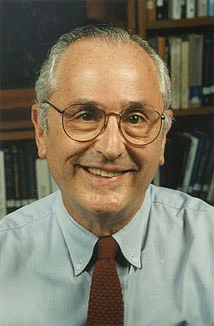
John N. Bahcall, Richard Black Professor in the School of Natural Sciences at the Institute for Advanced Study, has been awarded the 2003 Benjamin Franklin Medal in Physics by the Franklin Institute in Philadelphia. The Franklin Institute cites astrophysicist Bahcall and co-honorees Raymond Davis, Research Professor in the Department of Physics and Astronomy at the University of Pennsylvania, and Masatoshi Koshiba, Emeritus Professor of Physics at the University of Tokyo, for “work that led to an understanding of neutrino emission from the sun.”
The trio’s groundbreaking work, says the citation, “led to the discovery of solar neutrinos, furthering our understanding of the internal processes of the Sun and stars in general. Their research demonstrated that the nuclear reactions that produce neutrinos also cause the Sun to shine. Specifically, nuclear fusion among light elements is responsible for energy generation in the Sun.” The citation notes that Bahcall “provided the theoretical basis for the experimental work of first Davis, and then Koshiba.”
Born in Shreveport, La., Bahcall received his B.A. in physics in 1956 from the University of California at Berkeley, his M.S. from the University of Chicago in 1957, and his Ph.D. from Harvard University in 1961. After a research associateship at Indiana University, Bahcall became Associate Professor of Theoretical Physics at the California Institute of Technology. He was a member in the School of Natural Sciences at the Institute for Advanced Study in 1968, becoming a member of the permanent faculty in 1971. He was named to the Black Professorship in 1997.
Bahcall is a member of the National Academy of Sciences, the American Academy of Arts and Sciences, the Academia Europea, and the American Philosophical Society. A member of the Hubble Telescope Working Group for more than 20 years, in 1993 he won the NASA Distinguished Public Service Medal for observational studies using the Hubble. In 1998, he was awarded the nation’s highest science honor, the National Medal of Science, for his pioneering efforts in neutrino astrophysics and his contributions to the development and planning of the Space Telescope.
Other honors have included the 1994 Heineman Prize of the American Astronomical Society and the American Institute of Physics for his work on solar neutrinos, and the 1998 Hans Bethe Prize of the American Physical Society for his work on solar neutrinos as well as “important contributions to other areas of astrophysics.”
In 1999, he received the American Astronomical Society’s highest honor, the Henry Norris Russell Lectureship, which recognizes a lifetime of eminence in astronomical research.
Bahcall is the author of seven books and over 400 scientific papers as well as many articles in nonscientific publications.
Franklin Institute awards are among the most venerable science and technology awards programs in the world, and are sometimes called “the American Nobel Prizes.” Previous award winners include Stephen Hawking, Alexander Graham Bell, Albert Einstein, Thomas Edison, Marie and Pierre Curie, and the Wright brothers.
Bahcall and the other 2003 laureates will be honored at the awards celebration at the Franklin Institute on April 24.